
Commissioning a Common-Chemical Leach Route Without Rebuilding the Circuit
The reagent changes; the tanks, screens and Carbon circuit do not. What still has to be rebuilt is the validation logic.
AuLeach™ Gold Leaching Agent (GDA) – Non-Hazardous is a common-chemical Ath-ghnìomhaiche Leaching Òir that drops into existing CIP, CIL, CIC, Heap leaching and Vat leaching circuits without a process redesign. It ships as general cargo under FOB or CIF terms, so the Class 6.1 permit chain that gates Sodium cyanide deliveries does not apply. That advantage is logistical, not metallurgical: dosage and pH still have to be fixed ore by ore, and local common-chemical import rules still have to be confirmed by the buyer.
Na prìomh ghiùlan-bidhe
- Non-Hazardous is a classification, not a performance claim. It describes how the product ships and is declared, not what recovery a given ore will deliver.
- The circuit stays. Existing tanks, agitation, screens and carbon adsorption stages are retained; the reagent and its control band change.
- Dosage is ore-dependent. The indicative 0.5–1.0 ‰ range must be fixed by bottle roll or column testing on the plant's own feed.
- pH 10.5–12 is the operating window, with a working target around 11 ± 1. Outside that band, dissolution and reagent stability both suffer.
- General cargo removes a schedule risk, but the buyer still confirms the destination's common-chemical import rules against the shipped documentation.
- Adsorption still needs AuCarb™. A different leach chemistry does not remove the need for a properly specified carbon circuit.
bathar: Àidseant Lachaidh Òir AuLeach™ (GDA) – Gun Chunnart · Terms: FOB or CIF · MOQ 28 MT per 1×20' FCL · Documents: batch COA, TDS, MSDS.
| paramadair | Sònrachadh | Carson a tha e cudromach |
|---|---|---|
| Seòrsachadh | Non-Hazardous (common chemical) | General-cargo booking and declaration |
| Appearance / density | White to grey-white powder · 1.20–1.35 g/cm³ | Dosing and make-up handling |
| Ag obrachadh pH | 10.5–12 (target 11 ± 1) | Dissolution stability and reagent control |
| Indicative dosage | 0.5–1.0 ‰ (500–1000 g/t ore) | Starting band before ore-specific validation |
| Packaging / MOQ | Net 25 kg bag · 28 MT | FCL planning and freight comparability |
Applicability covers oxide, primary, semi-oxide, sulfide, high-arsenic and refractory ores, gold concentrates and cyanide tailings. Exact dosage is ore-dependent and must be fixed by laboratory testing before a plant campaign.
1. What changes and what does not
A leaching circuit is a set of unit operations: make-up and dosing, alkaline conditioning, dissolution under agitation or percolation, solid-liquid separation, and recovery of dissolved gold onto carbon. Switching to a common-chemical reagent changes the make-up chemistry and the control band. It does not, by itself, require new tanks, new screens or a new adsorption train. That is why the route is attractive for plants that already run CIP, CIL, CIC, Heap leaching or Vat leaching and want to avoid a capital project.
What must change is the validation package. A cyanide circuit has decades of shared operating heuristics; a common-chemical route does not. The plant needs its own dissolution curve, its own pH response, its own dosage calibration and its own residual-reagent measurement routine. Treating the indicative band as a fixed recipe is the most common commissioning error.
2. Four commissioning difficulties
2.1 Ore-specific response
Oxide ore, primary sulphide ore, high-arsenic material and cyanide tailings do not consume reagent at the same rate. A dosage that works on an oxide stockpile can under-dose a sulphide blend. Each distinct feed needs its own test curve.
2.2 pH drift during the campaign
Acidic ore components, make-up water quality and reagent degradation all move pH. Outside the 10.5–12 window, dissolution slows and control becomes erratic. pH must be logged at defined intervals, not checked once at start-up.
2.3 Residual reagent and solution balance
Recirculated process water accumulates dissolved salts and residual reagent. Without a measurement routine, the apparent consumption drifts and operators compensate by over-dosing, which raises cost without raising recovery.
2.4 Local import classification
General-cargo status removes the Class 6.1 chain, but destination authorities still apply their own common-chemical rules. The buyer confirms those rules against the shipped TDS and MSDS before the order is released.
3. Tutorial: seven-step commissioning sequence
- Characterise each feed separately. Record head grade, mineralogy, clay and sulphide content, arsenic level and particle size for every ore type or tailings stream that will enter the circuit.
- Run bottle roll tests across the 0.5–1.0 ‰ band at pH 10.5–12, sampling dissolved gold at 2, 6, 12 and 24 hours. Produce a curve per feed, not a single pass/fail result.
- Map the pH response. Identify where dissolution peaks and how quickly pH drifts for each feed; set the control band and the correction agent from that data.
- Fix the dosage by feed. Convert the laboratory optimum into kg/t of ore using pulp density and throughput, then define a separate set-point for each blend.
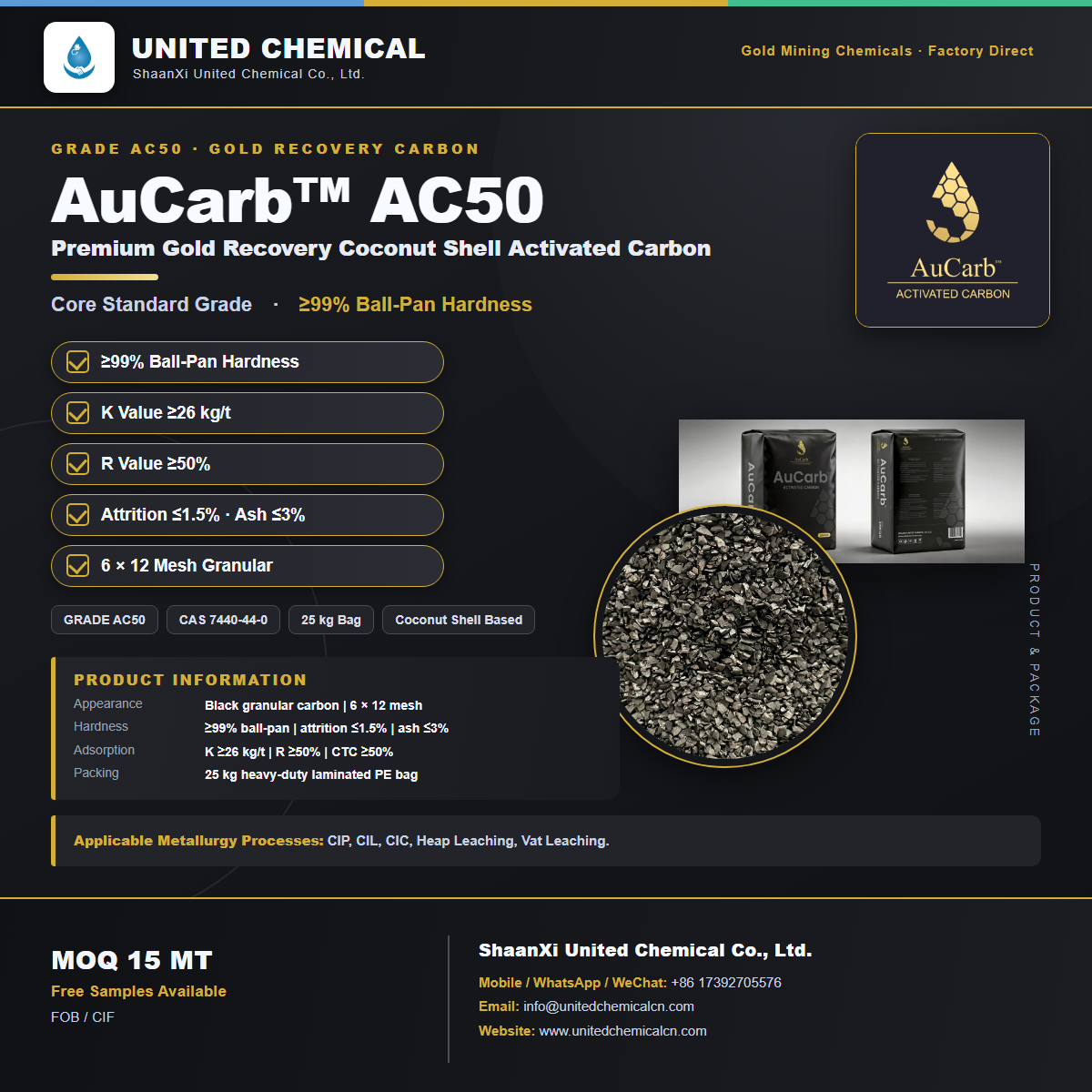
- Validate the adsorption stage. Confirm that AuCarb™ Gold Recovery Coconut Shell Activated Carbon (≥99% Hardness) still delivers the required K/R performance in the new solution chemistry before scaling up.
- Run a controlled plant trial on one circuit or one heap cell, logging pH, dosage, dissolved gold, residual reagent and recovery against the batch COA.
- Freeze the operating window and review it whenever the feed blend, water quality or throughput changes. Keep the test curves with the batch documentation for traceability.
The sequence is deliberately conservative: the reagent removes a logistics constraint, but it does not remove the need for metallurgical evidence. Plants that compress steps 1–5 into a single trial usually spend more time diagnosing the plant than they saved on the schedule.
4. Clàr fuasgladh dhuilgheadasan
| Symptom | Adhbhar coltach | A’ chiad sgrùdadh |
|---|---|---|
| Recovery below bottle roll result | Scale-up gap in agitation, residence time or pH control | Plant pH log, residence time, mixing energy |
| Consumption climbing at fixed feed | Ath-ghnìomhaiche fuigheallach ann an uisge ath-chuairtichte | Solution balance, make-up water quality |
| Dissolution stalls mid-campaign | pH drifting out of the 10.5–12 band | pH profile, buffering capacity, correction rate |
| Carbon loading lower than expected | Ceimigeachd fuasglaidh ùr a’ toirt buaidh air ìre adsorption | R value retest, stage-by-stage solution tenor |
| High-arsenic ore underperforms | Feed-specific dosage not calibrated | Dedicated bottle roll curve for that blend |
| Shipment held at destination | Local common-chemical rules not confirmed | TDS, MSDS and import classification against local rules |
5. Three products, three decisions
| Co-dhùnadh | bathar | Governing constraint |
|---|---|---|
| Established cyanide circuit | AuCyan™ Sòidiam Cianaid NaCN (≥98.3%) | Permit chain, free-cyanide control |
| Permit-constrained or general-cargo route | Àidseant Lachaidh Òir AuLeach™ (GDA) – Gun Chunnart | pH band, ore-specific dosage validation |
| Gold recovery from solution | Gual-fhiodha Gnìomhaichte Slige Chnò-choille Ath-bheothachaidh Òir AuCarb™ (Cruas ≥99%) | Hardness, K/R values, attrition, mesh cut |
All three ship under FOB or CIF terms with batch COA, TDS and MSDS. Free laboratory test samples are available for AuCarb™ and AuLeach™ so validation can start before an FCL order.
AngloGold Ashanti's 5 November 2026 brownfield programme includes roughly US$70 million at Siguiri in Guinea for about 100,000 oz/y of additional output, where Block 3 starts at the end of the year with 1.22 g/t feed replacing low-grade stockpile material. A change of feed grade on an existing circuit is precisely the condition under which a reagent control band must be re-validated rather than carried over. Source: company expansion announcement, 5 November 2026.
6. Ceistean Bitheanta
Q1. What does Non-Hazardous mean for this product?
It is a common-chemical classification that allows general-cargo booking and declaration. It is a shipping and regulatory description, not a recovery guarantee.
Q2. Does the plant need new tanks or screens?
No. AuLeach™ Gold Leaching Agent (GDA) – Non-Hazardous is designed to drop into existing CIP, CIL, CIC, Heap leaching and Vat leaching circuits without a process redesign.
Q3. What pH should the circuit hold?
An operating window of 10.5–12, with a working target around 11 ± 1, verified by routine measurement rather than a single start-up check.
Q4. What is the indicative dosage?
0.5–1.0 ‰, equivalent to 500–1000 g per tonne of ore. The figure is a starting band; the actual set-point is fixed by bottle roll or column testing on the plant's own feed.
Q5. Which ore types can be evaluated?
Oxide, primary, semi-oxide, sulfide, high-arsenic and refractory ores, gold concentrates and cyanide tailings — each with its own test curve.
Q6. Why does a feed change require re-validation?
Different mineralogy changes reagent demand, pH drift and dissolution kinetics. A dosage calibrated on an oxide stockpile will not automatically fit a sulphide blend.
Q7. Is the carbon circuit still needed?
Yes. Dissolved gold is still recovered by adsorption, so AuCarb™ Gold Recovery Coconut Shell Activated Carbon (≥99% Hardness) remains part of the flowsheet.
Q8. Does general-cargo status remove all import formalities?
No. The Class 6.1 permit chain does not apply, but the buyer still confirms local common-chemical import rules against the shipped TDS and MSDS.
C9. Dè na teirmichean Incoterm a tha rim faighinn?
Tha teirmichean FOB no CIF an sàs.
Q10. What is the minimum order?
28 MT per 1×20' FCL, packed in net 25 kg bags.
Q11. Can a laboratory sample be provided before an FCL order?
Yes — AuLeach™ test samples are available for laboratory validation alongside AuCarb™ samples.
Q12. When should a plant keep its cyanide route instead?
Where permits are in place and the cyanidation circuit is already optimised, AuCyan™ Sodium Cyanide NaCN (≥98.3%) remains the established dissolution benchmark. The common-chemical route is an alternative when the permit chain is the binding constraint.
7. Leughadh teicnigeach agus ceanglaichean a-staigh
AuLeach™ GDA product page · Leaching reagents reference · Sealladh farsaing air an Triantan Òir · Sealladh farsaing teicnigeach air trì toraidhean · AuCyan™ · Stiùireadh AuCarb™ · AC50 · AC55 · AC60 · BC1100 · Ceistean Cumanta ceimigeach · gnìomhachas Naidheachdan
Fios · WhatsApp +86 173 9270 5576 · info@unitedchemicalcn.com
- Susbaint air thuaiream
- Susbaint teth
- Susbaint lèirmheas teth
- Fuasglaidhean ceimigeach mèinnearachd agus giollachd mèinnearachd gnàthaichte agus taic theicnigeach airson Myanmar
- Na 20 ath-bheachdan as cudromaiche ann an giullachd mèinnearachd
- Sìona Shaanxi United Chemical's Òr Àrd-chruaidh gualain Gnìomhaichte Sònraichte
- A’ Seòladh Atharrachadh: Stiùir a’ Ghnìomhachais Cheimigeach san àm ri teachd
- potasium hydroxide (solide)
- Sòidiam hexametaphosphate
- Cloride ferric (cruaidh)
- 1Sodium cyanide lasaichte (CAS: 143-33-9) airson mèinnearachd - Càileachd Àrd & Prìsean farpaiseach
- 2Sodium Cyanide 98.3% CAS 143-33-9 NaCN òr sgeadachaidh àidseant riatanach airson mèinnearachd ceimigeach gnìomhachasan
- 3Riaghailtean Ùra Sìona air Às-mhalairt Sodium Cyanide agus Stiùireadh do Cheannaichean Eadar-nàiseanta
- 4Sodium Cyanide (CAS: 143-33-9) Teisteanas cleachdaiche deireannach (dreach Sìneach is Beurla)
- 5Cianide eadar-nàiseanta (Sodium cyanide) Còd Riaghlaidh - Inbhean Gabhail Mèinnean Òir
- 6Factaraidh Sìona Sulphuric Acid 98%
- 7Anhydrous Oxalic acid 99.6% gnìomhachais ìre
- 1Sodium Cyanide 98.3% CAS 143-33-9 NaCN òr sgeadachaidh àidseant riatanach airson mèinnearachd ceimigeach gnìomhachasan
- 2Glanachd Àrd · Coileanadh Seasmhach · Ath-bheothachadh nas àirde — sodium cyanide airson lionadh òir an latha an-diugh
- 3United ChemicalTha Sgioba Rannsachaidh a’ sealltainn ùghdarras tro lèirsinn stèidhichte air dàta
- 4Cianaid sodium àrd-choileanaidh AuCyan™ | Purrachd 98.3% airson mèinnearachd òir cruinneil
- 5Detonator dealanach didseatach (Dàil ùine 0 ~ 16000ms)
- 6Inneal-sgrios Tube Shock Àrd-neart, àrd-chruinneas
- 7Electric Detonator gnìomhachas


Co-chomhairle teachdaireachd air-loidhne
Cuir beachd ris: