
Hard-Rock Ore Variability and the Case for Consistent Reagent Specifications
When the ore changes from block to block, the one thing that should not change is the reagent you are measuring it against.
AngloGold Ashanti plans to invest US$200–250 million at the Cuiabá gold operation in Brazil, adding roughly 75,000 ounces of annual production to a 2025 base of 194,000 ounces. It is a brownfield expansion on an existing hard-rock circuit. For a plant whose ore varies from block to block, the procurement priority is not a new reagent but a stable one: one assay, one mesh cut, one K/R specification and one documentation standard per lot, so any change in plant performance can be attributed to the ore rather than to the delivery.
Lugares para levar
- A brownfield increment, not a new plant. US$200–250 million adds about 75,000 oz/y on a 194,000 oz 2025 base.
- Hard-rock feed varies. Grind size, sulphide exposure and gold liberation change dissolution kinetics between blocks.
- Hold the reagent constant. A stable NaCN assay and a stable Carbono specification make ore variability measurable instead of ambiguous.
- COA per lot is the control instrument. Batch COA, TDS and MSDS let operators separate ore effects from delivery effects.
- Carbon hardness ≥99% and attrition ≤1.5% keep loaded fines off the tailings stream when throughput rises.
- One qualification, one freight plan. FOB or CIF only, with 15 / 18 / 28 MT minimum order quantities per 1×20' FCL.
| Elemento | Figura revelada |
|---|---|
| Planned investment at Cuiabá | 200-250 millóns de dólares |
| Incremental production | ~75,000 oz/y |
| Base de 2025 | 194,000 oz |
| localización | Brazil, within the wider brownfield programme |
Source: company expansion announcement, 5 November 2026. All figures above are disclosed project numbers; no consumption figures have been estimated by the publisher.
1. Why ore variability makes specification stability valuable
In a hard-rock circuit, the ore delivered to the leach is never identical from one block to the next. Grind size changes liberation; sulphide and arsenic content change side-reaction demand; clay changes pulp rheology and oxygen transfer. Every one of those moves the dissolution curve and the reagent demand per tonne.
If the ore and the reagent both vary, the operator cannot tell which caused a change in recovery or consumption. Holding the reagent specification constant removes one variable. A NaCN assay that stays at ≥98.3%, a carbon lot that stays at ≥99% hardness with ≤1.5% attrition, and a fixed 6×12 mesh cut turn the reagent into a measuring instrument for the ore.
That is the practical argument for a single qualified supplier on a brownfield expansion: comparability. One set of test conditions, one documentation standard and one freight plan make deviations diagnosable.
2. Four difficulties in a variable hard-rock feed
2.1 Grind and liberation drift
Finer grind exposes more gold but also more gangue surface. Coarser grind leaves gold locked. Both change the optimum dosing profile, so the plant needs a curve per grind target.
2.2 Sulphide and arsenic side reactions
Copper, iron and arsenic minerals consume reagent through cyanocomplex formation. A new block with higher sulphide content raises consumption without raising recovery, which looks like a reagent problem unless the ore is tested.
2.3 Carbon fines at higher throughput
More circulation and screening cycles generate more fines. Because those fines carry adsorbed gold, the loss appears as a recovery gap rather than a consumable expense. Hardness ≥99% and attrition ≤1.5% on AC50 are the control points.
2.4 Multi-supplier drift
Two suppliers with nominally equivalent products can differ in assay, particle size distribution or impurity profile. Small differences compound across a long campaign and make trend data useless.
3. Tutorial: six steps to hold batch consistency
- Qualify one specification per product. Fix the NaCN assay band, the carbon hardness / attrition / mesh / K·R parameters and the leaching-agent pH and dosage band in writing before the first order.
- Require batch COA, TDS and MSDS per lot. File them against the delivery number, not in a shared folder, so any plant deviation can be traced to one lot.
- Sample on arrival. Retain a representative sample of each lot and verify the key assay or particle size parameter against the COA before the lot enters the circuit.
- Define an acceptance band. State what happens when a measured value falls outside it — hold, re-test or adjust the dosing set-point — and who authorises the decision.
- Log plant performance per lot. Consumption kg/t, pH, free cianuro or residual reagent, dissolved gold and recovery should all sit next to the lot number.
- Separate ore effects from delivery effects. When performance shifts, check the ore blend first (step 1 of the feed-change method), then the COA. Do not adjust the set-point until both are known.
This routine costs little and protects the most valuable thing a plant owns during an expansion: comparable data.
4. Táboa de resolución de problemas
| Síntoma | Causa probable | Primeira comprobación |
|---|---|---|
| Consumption up, recovery flat | New sulphide / arsenic block | Ore mineralogy, bottle roll curve |
| Recovery down after finer grind | Gangue surface consuming reagent | Grind size distribution, dosing profile |
| Carbon make-up rising | Fines from higher circulation | Attrition ≤1.5%, screen aperture, tails assay |
| Trend data inconsistent | Two suppliers or two specs in use | Qualification record, COA per lot |
| Deviation cannot be traced | Lot number not linked to plant log | Delivery record, sampling and filing routine |
5. Three products under one qualification
| Escenario | Produto | Fixed specification |
|---|---|---|
| Disolución | Cianuro de sodio AuCyan™ NaCN (≥98.3 %) | Assay band, low NaOH / Na₂CO₃ / insolubles; 18 MT MOQ |
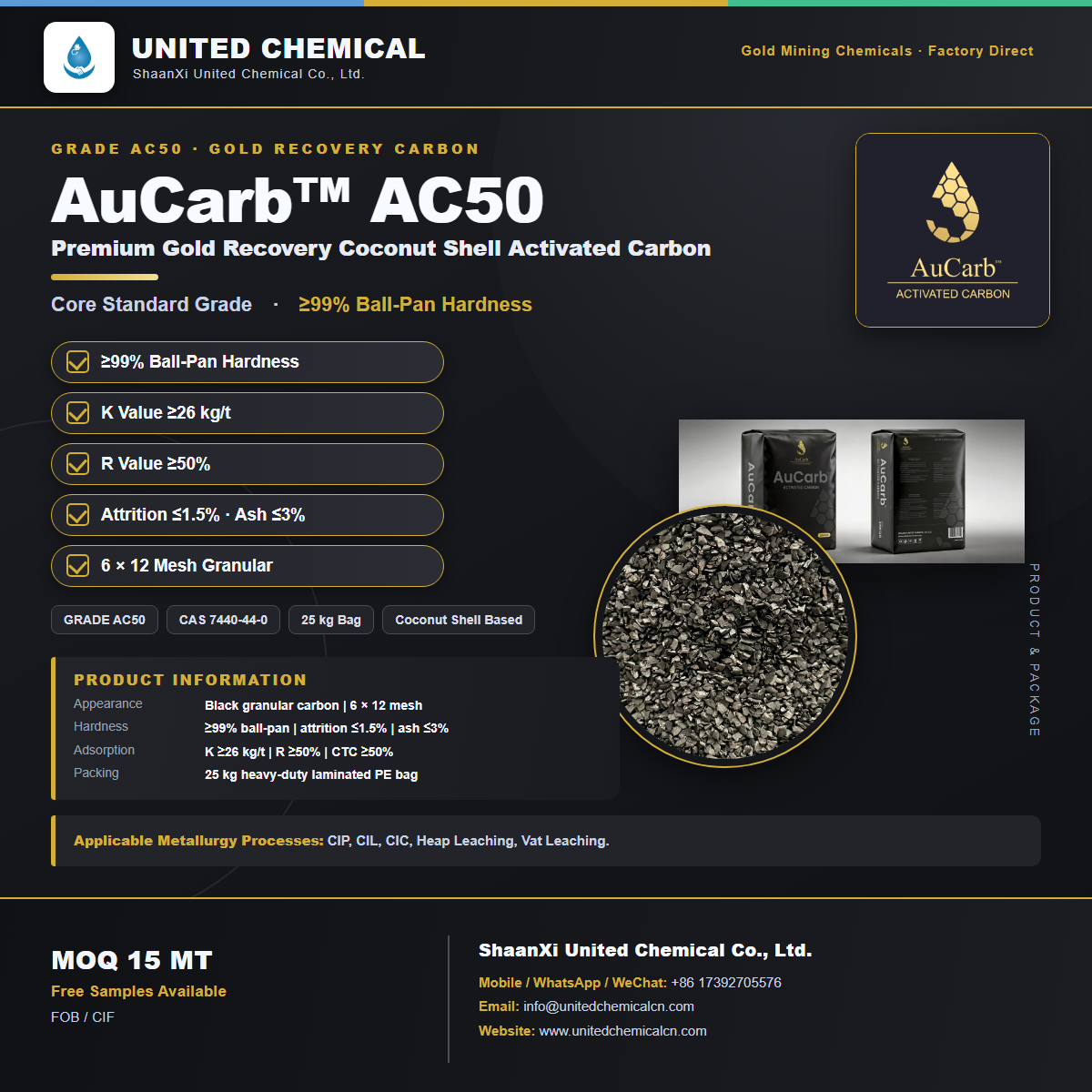
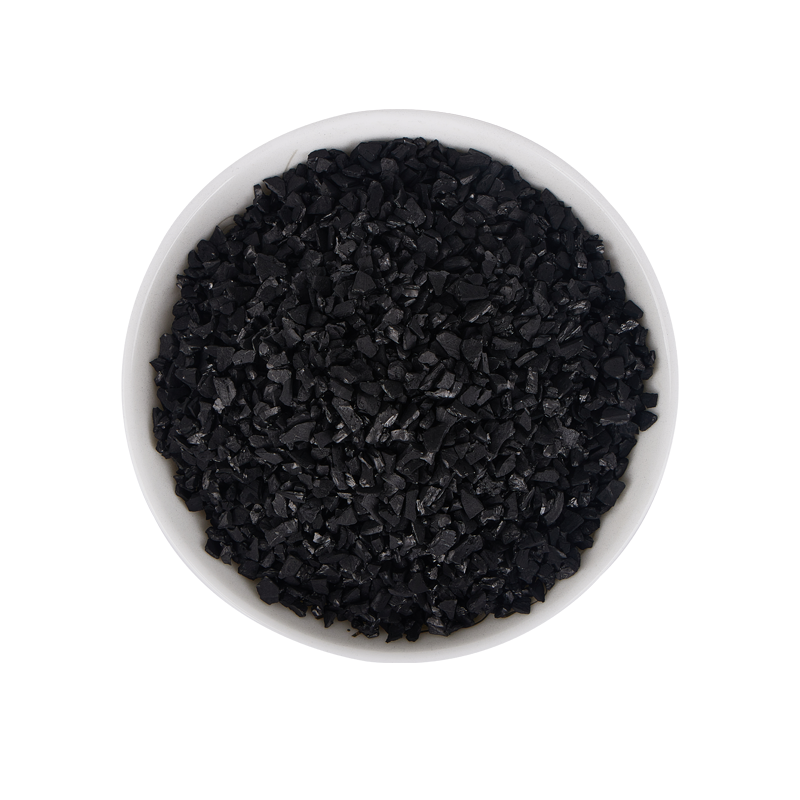
| Adsorción | Carbón activado de casca de coco para recuperación de ouro AuCarb™ (≥99 % de dureza) | 6×12 mesh, attrition ≤1.5%, K ≥26 kg/t / R ≥50% on AC50; 15 MT MOQ |
| Ruta alternativa | Axente de lixiviación de ouro (GDA) AuLeach™: non perigoso | pH 10.5–12, ore-validated dosage; 28 MT MOQ |
All three ship factory-direct under FOB or CIF terms with batch COA, TDS and MSDS; AuCarb™ is packed in 25 kg heavy-duty laminated PE bags. Free laboratory test samples are available for AuCarb™ and AuLeach™.
6. Preguntas máis frecuentes
Q1. What is planned at Cuiabá?
US$200–250 million of investment, adding roughly 75,000 ounces of annual production to a 2025 base of 194,000 ounces.
Q2. When was this announced?
5 de novembro de 2026, dentro do programa de expansión de zonas industriais abandonadas da empresa.
Q3. Why does hard-rock ore complicate reagent control?
Grind size, sulphide exposure, arsenic and clay content all change dissolution kinetics and side-reaction demand between blocks.
Q4. Why hold the reagent specification constant?
So any change in recovery or consumption can be attributed to the ore rather than to a varying delivery.
Q5. What documents should accompany each lot?
Batch COA, TDS and MSDS, filed against a delivery number so deviations are traceable.
Q6. What should be sampled on arrival?
A representative sample of each lot, verified against the COA for the key assay or particle size parameter before use.
Q7. Which carbon parameters matter most here?
Hardness ≥99%, attrition ≤1.5%, platelet ≤5.0%, a 6×12 mesh cut and the K/R pair on AC50.
P8. Como se envasa AuCarb™?
In 25 kg heavy-duty laminated PE bags at 15 MT MOQ per 1×20' FCL.
P9. Que Incoterms se aplican?
Aplícanse os termos FOB ou CIF.
Q10. What is the operating window for AuLeach™?
pH 10.5–12 with a target around 11 ± 1, with dosage fixed by ore-specific testing.
Q11. Should the set-point be adjusted when performance shifts?
Only after the ore blend and the batch COA have both been checked, so the cause is known before the change is made.
P12. Onde se publican as especificacións do produto?
On the AuCyan™, AuCarb™ and AuLeach™ technical pages linked below.
7. Fontes e ligazóns internas
AuCyan™ · Guía de AuCarb™ · AC50 · AC55 · AC60 · BC1100 · AuLeach™ GDA · Triángulo Dourado · Visión xeral de tres produtos · Preguntas frecuentes sobre produtos químicos · Novidades do sector · Contacte connosco
Nota da fonte: as cifras do proxecto proceden do anuncio de expansión da empresa do 5 de novembro de 2026. As especificacións dos reactivos son United Chemical datos do produto.
Contacto · WhatsApp +86 173 9270 5576 · info@unitedchemicalcn.com
- Contido aleatorio
- Contido quente
- Contido de críticas quente
- Fábrica de China ácido sulfúrico 98%
- Isopropil Xantato de sodio 90% SIPX
- Como elixo o floculante correcto?
- Como afectan os produtos químicos da minería as taxas de recuperación dos minerais durante a flotación?
- Tripolifosfato de sodio
- Ácido cianúrico
- Ditiofosfato de diisobutil sódico/ditiofosfato 49% - 53%
- 1Cianuro de sodio con desconto (CAS: 143-33-9) para minería: alta calidade e prezos competitivos
- 2Cianuro de sodio 98.3% CAS 143-33-9 NaCN axente de tratamento de ouro esencial para as industrias químicas mineiras
- 3Novas regulacións de China sobre exportacións de cianuro de sodio e orientacións para compradores internacionais
- 4Cianuro de sodio (CAS: 143-33-9) Certificado de usuario final (versión en chinés e inglés)
- 5Código de xestión internacional de cianuro (cianuro de sodio) - Normas de aceptación da mina de ouro
- 6Fábrica de China ácido sulfúrico 98%
- 7Ácido oxálico anhidro 99.6% Grao industrial
- 1Cianuro de sodio 98.3% CAS 143-33-9 NaCN axente de tratamento de ouro esencial para as industrias químicas mineiras
- 2Alta pureza · Rendemento estable · Maior recuperación: cianuro de sodio para a lixiviación moderna de ouro
- 3United ChemicalO equipo de investigación de demostra autoridade a través de información baseada en datos
- 4Cianuro de sodio de alto rendemento AuCyan™ | 98.3 % de pureza para a minería de ouro global
- 5Detonador electrónico dixital (Tempo de retardo 0 ~ 16000 ms)
- 6Detonador de tubo de choque de alta resistencia e alta precisión
- 7industria detonador eléctrico


Consulta de mensaxes en liña
Engadir comentario: