
Adsorption Kinetics, Attrition Control and the CIP/CIL Carbon Balance
Why ≥99% hardness, a 6×12 mesh cut and ≤1.5% attrition determine how much loaded gold stays in the circuit — and how much walks out as fines.
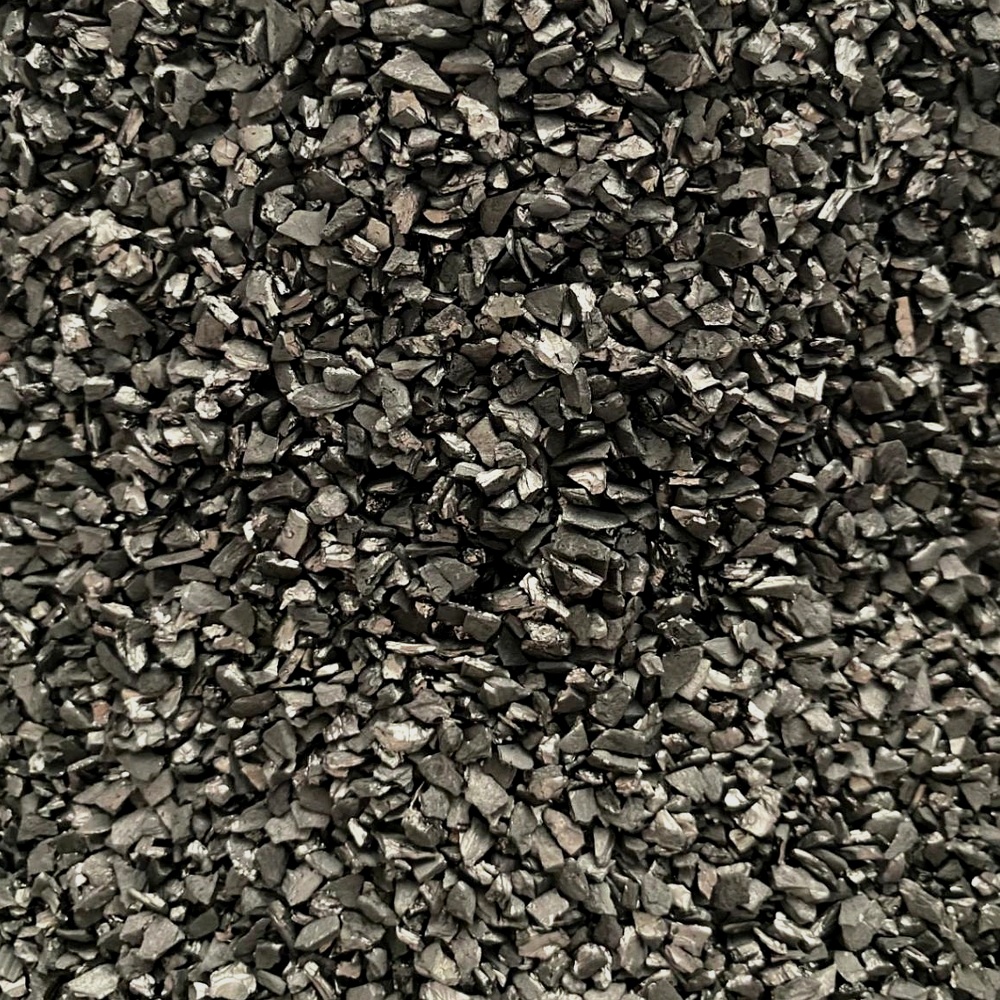
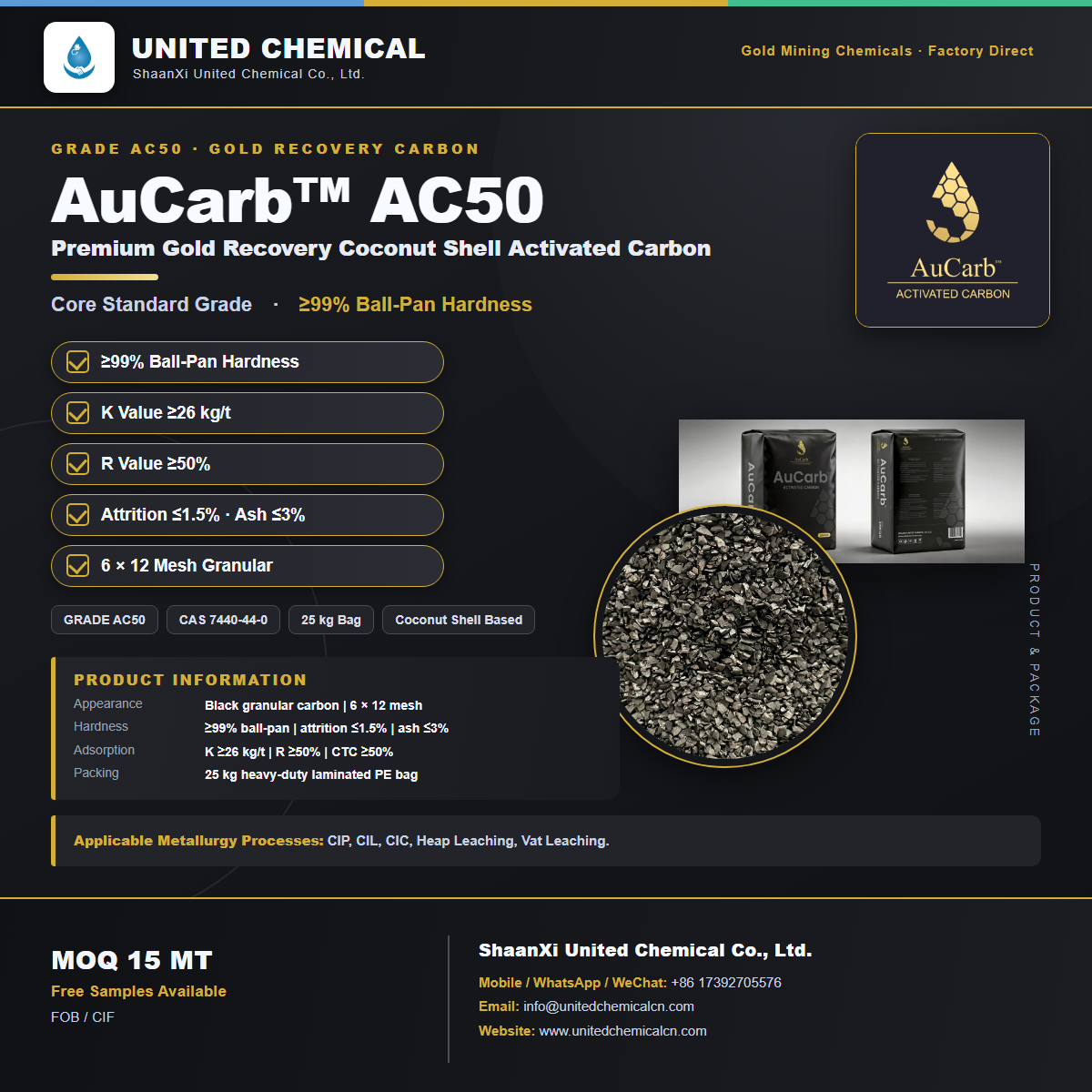
AuCarb™ Gold Recovery Coconut Shell Activated Carbon (≥99% Hardness) is a coconut-shell granular Karbon engineered for gold adsorption in CIP, CIL, CIC, Heap leaching and Vat leaching circuits. Its job is to pull the Au(CN)₂⁻ complex out of solution fast enough and hold it firmly enough that the carbon can be screened, eluted and reused. The three numbers that govern that job are hardness (survival under impeller shear), the K/R pair (capacity and speed) and attrition (how much loaded carbon grinds into unrecoverable fines).
Ndërmarrjet kryesore
- Fines carry gold. Every gram of carbon that grinds below the screen aperture leaves the circuit already loaded. Attrition is a recovery loss, not a housekeeping cost.
- Hardness ≥99% is measured, not claimed. Ball-pan hardness (ASTM D3802) plus A.A.R.L. attrition give comparable numbers across suppliers.
- K sets capacity, R sets speed. A carbon with a high K value but a weak R value fills slowly and lets gold pass the last adsorption stage.
- 6×12 mesh is a hydraulic decision. A tight cut keeps inter-stage screens from blinding while preserving contact area.
- Ash ≤3.0% protects thermal reactivation. Lower ash leaves cleaner micropores after repeated kiln cycles.
- Packing is fixed. 25 kg heavy-duty laminated PE bags, moisture ≤5.0% as packed, 15 MT MOQ per 1×20' FCL.
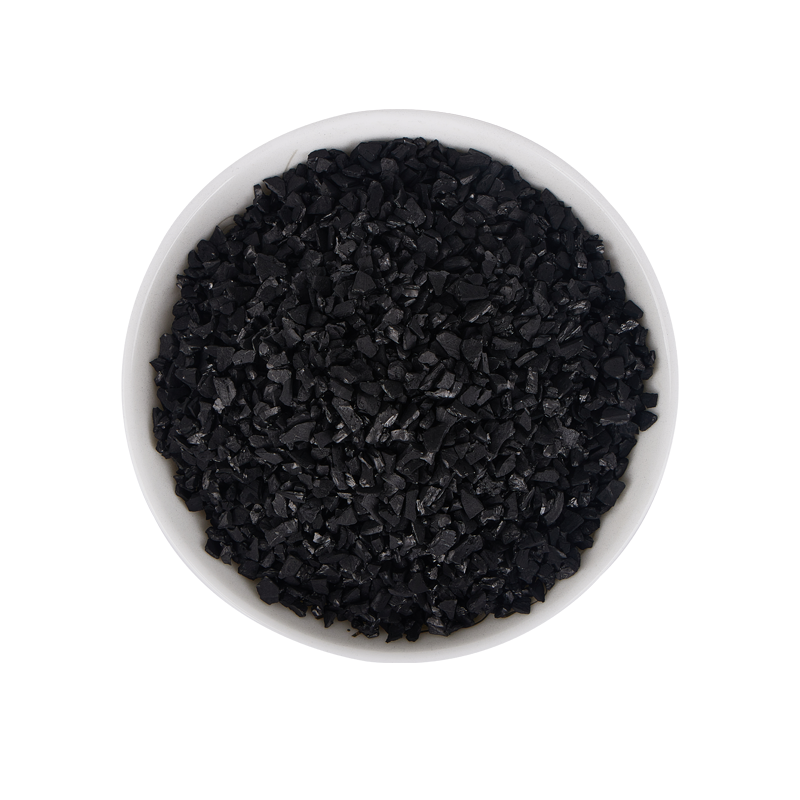
materiali: Kokosit Shell i grimcuar Karboni i aktivizuar · CAS 7440-44-0 · HS 3802.10 · Bulk density 0.48–0.55 g/ml · Packaging: 25 kg heavy-duty laminated PE bags · Terms: FOB or CIF · MOQ 15 MT · Documents: batch COA, TDS, MSDS.
| Parametër | AC50 value | Çfarë kontrollon |
|---|---|---|
| Rrjetë | 6 × 12 | Screen retention and contact area |
| Fortësia e një tepsie topi | ≥% 99 | Survival under impeller shear |
| Tretje (AARL) | ≤1.5% | Loaded-carbon loss to fines |
| Trombocitet | ≤5.0% | Screen blinding tendency |
| Vlera K | ≥26 kg/t | Equilibrium gold loading |
| R value | ≥% 50 | Shkalla e adsorbimit |
| CTC | ≥% 50 | Micropore volume indicator |
| Aktiviteti i butanit | ≥% 19.5 | Pore structure confirmation |
| hi | ≤3.0% | Reactivation cleanliness |
| Lagështi | ≤5.0% | Stability after sea transit |
Grade ladder: BC1100 for Heap leaching and CIC duty (≥98.5% hardness) → AC50 for standard CIP/CIL → AC55 (K ≥28 kg/t, R ≥55%) → AC60 (K ≥30 kg/t, R ≥60%, 8×16 or 6×12). Iodine number is deliberately omitted from this specification pending a single confirmed figure; CTC and Butane activity are the published pore indicators.
1. What actually happens inside an adsorption tank
Gold leaves the leach as the aurocyanide complex Au(CN)₂⁻. Adsorption onto coconut shell carbon happens in three consecutive steps: transport through the liquid film surrounding the granule, diffusion into the pore network, and physical adsorption on the internal surface. The slowest step sets the observed rate. In a well-agitated CIL tank the film is thin, so pore diffusion and surface loading dominate; in a low-agitation CIC column the film can become the bottleneck.
This is why two carbons with similar equilibrium capacity behave differently in a real plant. The K value describes how much gold a tonne of carbon can hold at equilibrium. The R value describes how quickly it approaches that equilibrium. A circuit sized only on K will trail gold in solution at the final stage because the carbon never gets there within the residence time available.
Coconut shell feedstock matters here: it produces a predominantly microporous structure with high mechanical strength. That combination gives the hardness needed to survive repeated screening, pumping and elution cycles while retaining the pore volume needed for fast loading.
2. Four failure modes in the carbon circuit
2.1 Attrition and loaded-gold loss
Impellers, pumps, transfer launders and screens all abrade granules. The resulting fines pass the inter-stage screens carrying adsorbed gold and are lost to the tailings stream or to the thickener overflow. Because the gold is already on the carbon, this loss is invisible to a solution assay of the tailings — it shows up only as a gap between dissolved gold and recovered gold.
2.2 Screen blinding from platelet content
Flat platelets orient across screen apertures and blind them far faster than equant granules. Blinded screens force bypassing, short-circuiting and uneven carbon distribution between stages. Holding platelet content at ≤5.0% keeps the screen cycle predictable.
2.3 Ash build-up across reactivation cycles
Each thermal reactivation leaves inorganic residue in the pores. High initial ash accelerates the decline in adsorption rate, so the carbon must be replaced sooner. Ash ≤3.0% extends the useful number of kiln cycles and lowers the effective cost per tonne of ore treated.
2.4 Poisoning by organics and flotation reagents
Frothers, collectors, oils and humic material adsorb strongly and occupy the micropores. A circuit that changes its grinding or flotation chemistry can see a sudden drop in R value without any change in the carbon delivered. Diagnose the solution chemistry before blaming the carbon lot.
3. Tutorial: a seven-step CIP/CIL carbon balance
- Set the carbon concentration in each adsorption stage (g/L of pulp) based on tank volume and target gold loading. Record it as a range, not a single figure.
- Measure the solution tenor entering and leaving each stage. The stage-by-stage profile tells you where adsorption is actually happening.
- Compute the equilibrium loading from the K value of the selected grade and the observed solution tenor; compare it with the measured loaded carbon assay.
- Check the kinetics against the R value and the real residence time per stage. If the measured loading lags the equilibrium figure, the stage is rate-limited, not capacity-limited.
- Calculate the carbon advance rate needed to keep the loaded carbon below the elution design limit, balancing gold inventory against elution throughput.
- Quantify attrition loss by comparing carbon inventory make-up against the design ≤1.5% figure, and convert the shortfall into contained gold using the loaded-carbon assay.
- Close the loop with reactivation. Log kiln cycles, ash trend and R value after each regeneration, then set the replacement rule from the measured decline rather than from a fixed calendar.
A worked balance is plant-specific: throughput, pulp density, solution tenor and the number of stages all change the answer. The method stays the same; the inputs come from your own sampling campaign.
4. Tabela e zgjidhjes së problemeve
| simptomë | Shkaku i mundshëm | Kontrolli i parë |
|---|---|---|
| Ari në zgjidhjen e fazës përfundimtare | Rate-limited adsorption, low R value or short residence | Stage profile, residence time, agitation |
| High carbon make-up rate | Attrition above design, aggressive pumping | Fines in tails, pump speed, transfer design |
| Screens blinding early | Platelet content or degraded granules | Particle shape distribution, screen aperture |
| Loading drops after flotation change | Organic poisoning of micropores | Reagent regime, solution TOC, R value retest |
| Capacity fading after kiln cycles | Ash accumulation in pores | Ash trend, reactivation temperature profile |
| Uneven carbon between stages | Screen bypass or air-lift imbalance | Stage inventory survey, advance rate |
5. Grade selection and the wider flowsheet
| Detyrë | Klasë | Logjika e përzgjedhjes |
|---|---|---|
| Heap leaching / CIC column | BC1100 | Lower shear, long contact, ≥98.5% hardness |
| Standard CIP / CIL | AC50 | Engineering grade, K ≥26 kg/t, R ≥50% |
| CIL me rendiment më të lartë | AC55 | K ≥28 kg/t, R ≥55% |
| High-shear / high-tenor duty | AC60 | K ≥30 kg/t, R ≥60%, 8×16 ose 6×12 |
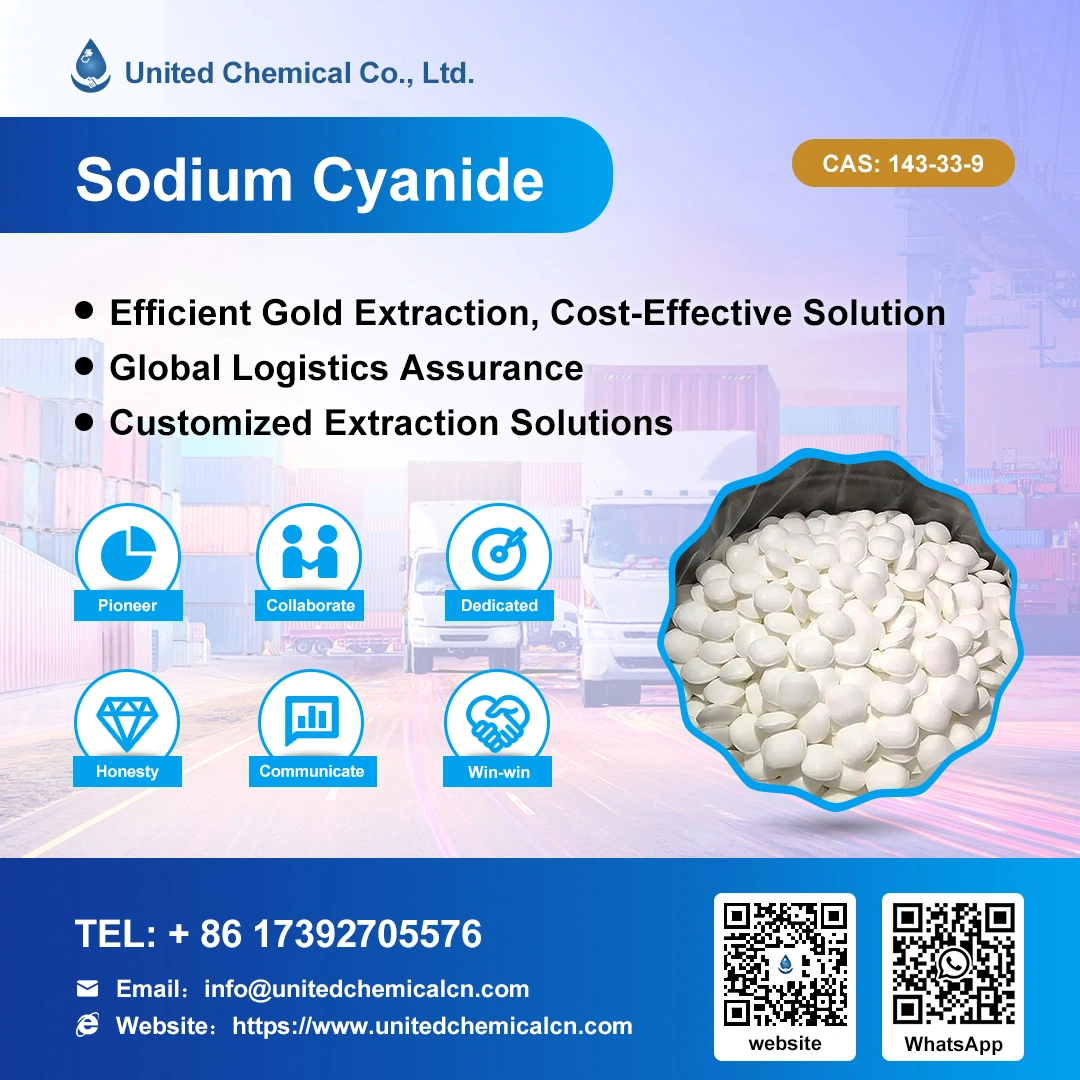
Adsorption sits after dissolution in the flowsheet. The leach stage is covered by AuCyan™ Cianur Natriumi NaCN (≥98.3%); where a common-chemical route is preferred, the circuit can be validated with AuLeach™ Agjent për Shpëlarjen e Arit (GDA) – Jo i Rrezikshëm. Sourcing all three from one manufacturer keeps test conditions, documentation and freight planning comparable.
AngloGold Ashanti's 5 November 2026 brownfield programme assigns US$480–580 million to Geita in Tanzania, targeting about 600,000 oz/y by 2030 against 492,000 oz in 2025. Q3 2026 output there was 120,000 oz, 4% lower year on year as mined grades declined. An expansion on an existing footprint raises carbon circulation and screening duty rather than introducing a new plant design — which is exactly where attrition, mesh cut and screen retention become the governing variables. Burimi: përditësimi i kompanisë për tremujorin e tretë të vitit 2026 dhe njoftimi i zgjerimit, 5 nëntor 2026.
6. Pyetjet e bëra më shpesh
Q1. What does ≥99% hardness actually measure?
Ball-pan hardness, tested to ASTM D3802, measures resistance to mechanical breakdown under controlled abrasion. It predicts how well granules survive impellers, pumps and screening.
Q2. Why is attrition ≤1.5% a recovery issue rather than a cost issue?
Because the fines that break away are already loaded with gold. They pass the screens and leave the circuit, so the loss appears as a recovery gap rather than a reagent expense.
Q3. What is the difference between the K value and the R value?
K is the equilibrium loading capacity in kg of gold per tonne of carbon; R is the rate at which the carbon approaches that equilibrium. Capacity without rate leaves gold in solution.
Q4. Why specify a 6×12 mesh cut?
A tight particle size distribution keeps inter-stage screens from blinding and gives predictable hydraulic behaviour while preserving enough surface area for adsorption.
Q5. How does platelet content affect the circuit?
Flat platelets bridge screen apertures. Holding platelet at ≤5.0% keeps screening cycles stable and prevents bypassing between adsorption stages.
Q6. Why do you publish CTC and Butane activity instead of an iodine number?
Those are the confirmed pore indicators for this grade. Until a single iodine figure is settled across all site documentation, the specification relies on CTC ≥50% and Butane ≥19.5%.
Q7. What does ash ≤3.0% protect?
Thermal reactivation. Lower inorganic residue leaves cleaner micropores after each kiln cycle and slows the decline in adsorption rate.
Q8. Which grade should a standard CIL plant start with?
AC50 is the engineering grade for standard CIP/CIL duty. Move to AC55 or AC60 when throughput, tenor or shear demands a higher K/R pair.
Q9. How is carbon packed and shipped?
In 25 kg heavy-duty laminated PE bags, moisture ≤5.0% as packed, at 15 MT MOQ per 1×20' FCL under FOB or CIF terms.
Q10. Can laboratory test samples be provided?
Yes — AuCarb™ and AuLeach™ test samples are available for laboratory validation on your own ore before an FCL order is placed.
Q11. Why does loading fall after a flotation reagent change?
Frothers, collectors and oils occupy the micropores and reduce the effective adsorption rate. Check solution chemistry before attributing the drop to the carbon lot.
Q12. Which products complete the rest of the flowsheet?
AuCyan™ Sodium Cyanide NaCN (≥98.3%) for dissolution and AuLeach™ Gold Leaching Agent (GDA) – Non-Hazardous for a common-chemical leach route.
7. Lexime teknike dhe lidhje të brendshme
Udhëzuesi AuCarb™ · AC50 · AC55 · AC60 · BC1100 · AC50 flagship page · Triangle Artë · AuCyan™ · AuLeach™ GDA · Reagentë për kullimin · Pyetjet e shpeshta kimike · Industry News
Kontakti · WhatsApp +86 173 9270 5576 · info@unitedchemicalcn.com
- Përmbajtje e rastësishme
- Përmbajtje e nxehtë
- Përmbajtje e nxehtë e rishikimit
- Acidi nitrik i koncentruar industrial 55%-68%
- Natriumi Isobutyl Xanthate SIBX 90%
- Detonator elektrik sizmik (Antistatike, Rezistencë ndaj ujit)
- Acidi acetik industrial 99.5% Lëng pa ngjyrë Acidi acetik akullnajor
- Çfarë roli luajnë kimikatet minerare në industrinë minerare?
- Si mund të zgjedh reagentin e duhur të flotacionit?
- Cilat janë masat paraprake për ruajtjen dhe trajtimin e kimikateve të minierave?
- 1Cianid natriumi me zbritje (CAS: 143-33-9) për miniera - Cilësi e lartë dhe çmime konkurruese
- 2Cianur Natriumi 98.3% CAS 143-33-9 Agjent salcimi ari NaCN Thelbësor për Industritë Kimike të Minierave
- 3Rregulloret e reja të Kinës për eksportet e cianidit të natriumit dhe udhëzimet për blerësit ndërkombëtarë
- 4Cianidi i natriumit (CAS: 143-33-9) Certifikata e përdoruesit përfundimtar (versioni kinez dhe anglisht)
- 5Kodi Ndërkombëtar i Menaxhimit të Cianidit (Cianid Natriumi) - Standardet e Pranimit të Minierës së Arit
- 6Fabrika e Kinës Acidi Sulfurik 98%
- 7Acid oksalik anhydrous 99.6% Klasa industriale
- 1Cianur Natriumi 98.3% CAS 143-33-9 Agjent salcimi ari NaCN Thelbësor për Industritë Kimike të Minierave
- 2Pastërti e Lartë · Performancë e Qëndrueshme · Rikuperim më i Lartë — cianur natriumi për shpëlarjen moderne të arit
- 3United ChemicalEkipi i Kërkimit të 's demonstron autoritet përmes njohurive të bazuara në të dhëna
- 4Cianur Natriumi me Performancë të Lartë AuCyan™ | Pastërti 98.3% për Minierat Globale të Arit
- 5Detonator elektronik dixhital (Koha e vonesës 0~ 16000ms)
- 6Detonator me tub goditjeje me qëndrueshmëri të lartë, me saktësi të lartë
- 7industria Detonator Elektrik



Konsultimi i mesazheve në internet
Shto koment: