
Commissioning a Common-Chemical Leach Route Without Rebuilding the Circuit
The reagent changes; the tanks, screens and Carbon circuit do not. What still has to be rebuilt is the validation logic.
AuLeach™ Gold Leaching Agent (GDA) – Non-Hazardous is a common-chemical Kitendanishi cha Kuchuja Dhahabu that drops into existing CIP, CIL, CIC, Heap leaching and Vat leaching circuits without a process redesign. It ships as general cargo under FOB or CIF terms, so the Class 6.1 permit chain that gates Sianidi ya sodiamu deliveries does not apply. That advantage is logistical, not metallurgical: dosage and pH still have to be fixed ore by ore, and local common-chemical import rules still have to be confirmed by the buyer.
Kuchukua Muhimu
- Non-Hazardous is a classification, not a performance claim. It describes how the product ships and is declared, not what recovery a given ore will deliver.
- The circuit stays. Existing tanks, agitation, screens and carbon adsorption stages are retained; the reagent and its control band change.
- Dosage is ore-dependent. The indicative 0.5–1.0 ‰ range must be fixed by bottle roll or column testing on the plant's own feed.
- pH 10.5–12 is the operating window, with a working target around 11 ± 1. Outside that band, dissolution and reagent stability both suffer.
- General cargo removes a schedule risk, but the buyer still confirms the destination's common-chemical import rules against the shipped documentation.
- Adsorption still needs AuCarb™. A different leach chemistry does not remove the need for a properly specified carbon circuit.
bidhaa: Wakala wa Kuchuja Dhahabu wa AuLeach™ (GDA) – Sio Hatari · Terms: FOB or CIF · MOQ 28 MT per 1×20' FCL · Documents: batch COA, TDS, MSDS.
| Kigezo | Vipimo | Kwa nini ni muhimu |
|---|---|---|
| Ainisho ya | Non-Hazardous (common chemical) | General-cargo booking and declaration |
| Appearance / density | White to grey-white powder · 1.20–1.35 g/cm³ | Dosing and make-up handling |
| pH ya uendeshaji | 10.5–12 (target 11 ± 1) | Dissolution stability and reagent control |
| Indicative dosage | 0.5–1.0 ‰ (500–1000 g/t ore) | Starting band before ore-specific validation |
| Packaging / MOQ | Net 25 kg bag · 28 MT | FCL planning and freight comparability |
Applicability covers oxide, primary, semi-oxide, sulfide, high-arsenic and refractory ores, gold concentrates and sianidi tailings. Exact dosage is ore-dependent and must be fixed by laboratory testing before a plant campaign.
1. What changes and what does not
A leaching circuit is a set of unit operations: make-up and dosing, alkaline conditioning, dissolution under agitation or percolation, solid-liquid separation, and recovery of dissolved gold onto carbon. Switching to a common-chemical reagent changes the make-up chemistry and the control band. It does not, by itself, require new tanks, new screens or a new adsorption train. That is why the route is attractive for plants that already run CIP, CIL, CIC, Heap leaching or Vat leaching and want to avoid a capital project.
What must change is the validation package. A cyanide circuit has decades of shared operating heuristics; a common-chemical route does not. The plant needs its own dissolution curve, its own pH response, its own dosage calibration and its own residual-reagent measurement routine. Treating the indicative band as a fixed recipe is the most common commissioning error.
2. Four commissioning difficulties
2.1 Ore-specific response
Oxide ore, primary sulphide ore, high-arsenic material and cyanide tailings do not consume reagent at the same rate. A dosage that works on an oxide stockpile can under-dose a sulphide blend. Each distinct feed needs its own test curve.
2.2 pH drift during the campaign
Acidic ore components, make-up water quality and reagent degradation all move pH. Outside the 10.5–12 window, dissolution slows and control becomes erratic. pH must be logged at defined intervals, not checked once at start-up.
2.3 Residual reagent and solution balance
Recirculated process water accumulates dissolved salts and residual reagent. Without a measurement routine, the apparent consumption drifts and operators compensate by over-dosing, which raises cost without raising recovery.
2.4 Local import classification
General-cargo status removes the Class 6.1 chain, but destination authorities still apply their own common-chemical rules. The buyer confirms those rules against the shipped TDS and MSDS before the order is released.
3. Tutorial: seven-step commissioning sequence
- Characterise each feed separately. Record head grade, mineralogy, clay and sulphide content, arsenic level and particle size for every ore type or tailings stream that will enter the circuit.
- Run bottle roll tests across the 0.5–1.0 ‰ band at pH 10.5–12, sampling dissolved gold at 2, 6, 12 and 24 hours. Produce a curve per feed, not a single pass/fail result.
- Map the pH response. Identify where dissolution peaks and how quickly pH drifts for each feed; set the control band and the correction agent from that data.
- Fix the dosage by feed. Convert the laboratory optimum into kg/t of ore using pulp density and throughput, then define a separate set-point for each blend.
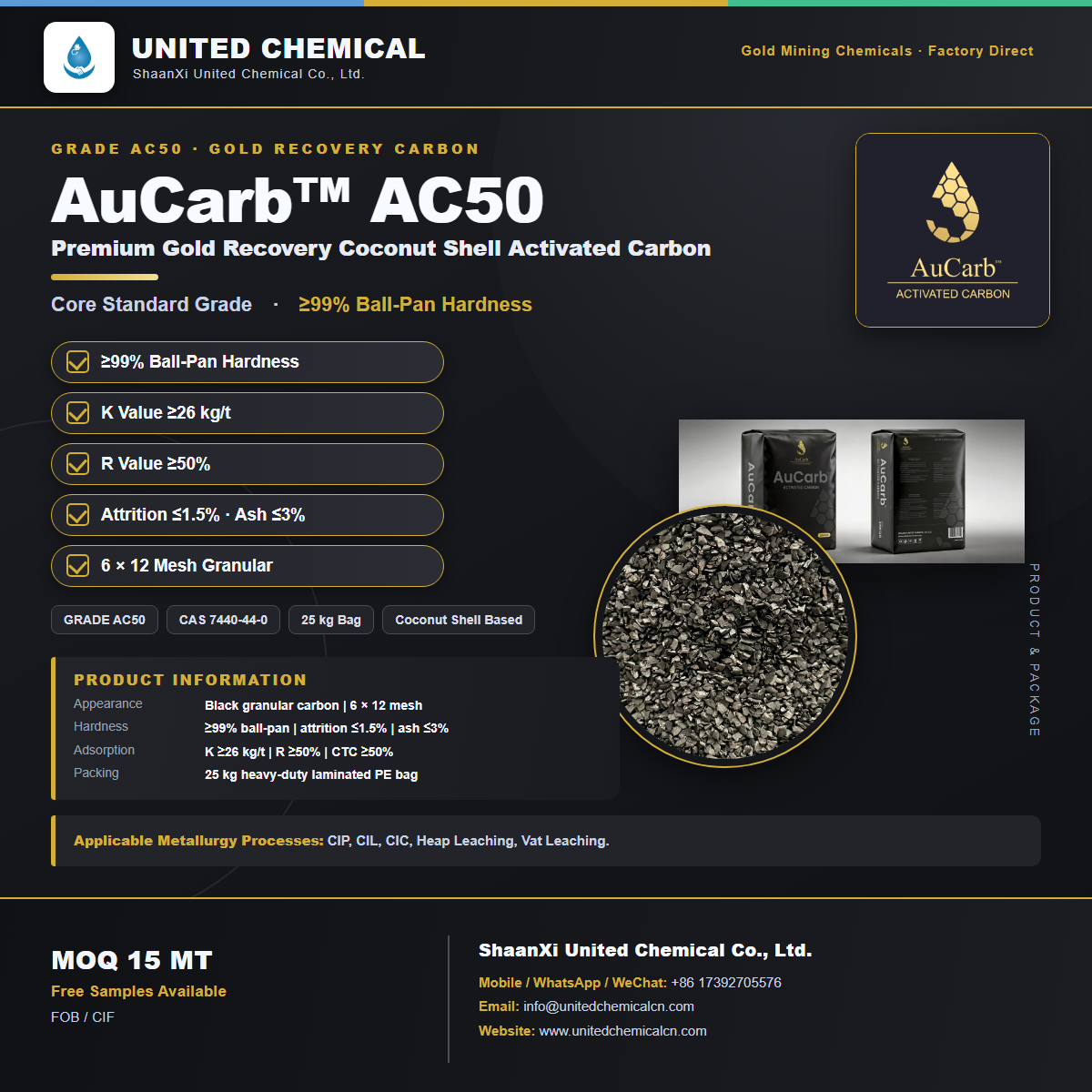
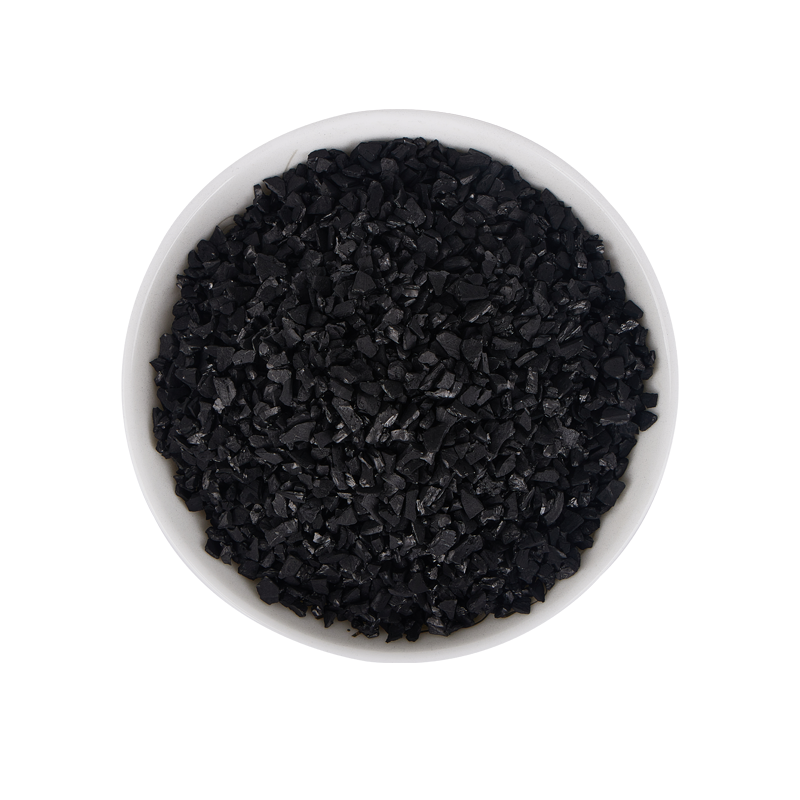
- Validate the adsorption stage. Confirm that AuCarb™ Gold Recovery Coconut Shell Activated Carbon (≥99% Hardness) still delivers the required K/R performance in the new solution chemistry before scaling up.
- Run a controlled plant trial on one circuit or one heap cell, logging pH, dosage, dissolved gold, residual reagent and recovery against the batch COA.
- Freeze the operating window and review it whenever the feed blend, water quality or throughput changes. Keep the test curves with the batch documentation for traceability.
The sequence is deliberately conservative: the reagent removes a logistics constraint, but it does not remove the need for metallurgical evidence. Plants that compress steps 1–5 into a single trial usually spend more time diagnosing the plant than they saved on the schedule.
4. Jedwali la utatuzi wa matatizo
| Dalili | Uwezekano wa sababu | Ukaguzi wa kwanza |
|---|---|---|
| Recovery below bottle roll result | Scale-up gap in agitation, residence time or pH control | Plant pH log, residence time, mixing energy |
| Consumption climbing at fixed feed | Kitendanishi kilichobaki katika maji yaliyozungushwa tena | Solution balance, make-up water quality |
| Dissolution stalls mid-campaign | pH drifting out of the 10.5–12 band | pH profile, buffering capacity, correction rate |
| Carbon loading lower than expected | Kemia mpya ya suluhisho inayoathiri kiwango cha ufyonzaji | R value retest, stage-by-stage solution tenor |
| High-arsenic ore underperforms | Feed-specific dosage not calibrated | Dedicated bottle roll curve for that blend |
| Shipment held at destination | Local common-chemical rules not confirmed | TDS, MSDS and import classification against local rules |
5. Three products, three decisions
| Uamuzi | Bidhaa | Governing constraint |
|---|---|---|
| Established cyanide circuit | AuCyan™ Sodiamu Sianidi NaCN (≥98.3%) | Permit chain, free-cyanide control |
| Permit-constrained or general-cargo route | Wakala wa Kuchuja Dhahabu wa AuLeach™ (GDA) – Sio Hatari | pH band, ore-specific dosage validation |
| Gold recovery from solution | Kaboni Iliyoamilishwa ya Shell ya Nazi ya AuCarb™ Gold Recovery (≥99% Ugumu) | Hardness, K/R values, attrition, mesh cut |
All three ship under FOB or CIF terms with batch COA, TDS and MSDS. Free laboratory test samples are available for AuCarb™ and AuLeach™ so validation can start before an FCL order.
AngloGold Ashanti's 5 November 2026 brownfield programme includes roughly US$70 million at Siguiri in Guinea for about 100,000 oz/y of additional output, where Block 3 starts at the end of the year with 1.22 g/t feed replacing low-grade stockpile material. A change of feed grade on an existing circuit is precisely the condition under which a reagent control band must be re-validated rather than carried over. Source: company expansion announcement, 5 November 2026.
6. Maswali yanayoulizwa mara kwa mara
Q1. What does Non-Hazardous mean for this product?
It is a common-chemical classification that allows general-cargo booking and declaration. It is a shipping and regulatory description, not a recovery guarantee.
Q2. Does the plant need new tanks or screens?
No. AuLeach™ Gold Leaching Agent (GDA) – Non-Hazardous is designed to drop into existing CIP, CIL, CIC, Heap leaching and Vat leaching circuits without a process redesign.
Q3. What pH should the circuit hold?
An operating window of 10.5–12, with a working target around 11 ± 1, verified by routine measurement rather than a single start-up check.
Q4. What is the indicative dosage?
0.5–1.0 ‰, equivalent to 500–1000 g per tonne of ore. The figure is a starting band; the actual set-point is fixed by bottle roll or column testing on the plant's own feed.
Q5. Which ore types can be evaluated?
Oxide, primary, semi-oxide, sulfide, high-arsenic and refractory ores, gold concentrates and cyanide tailings — each with its own test curve.
Q6. Why does a feed change require re-validation?
Different mineralogy changes reagent demand, pH drift and dissolution kinetics. A dosage calibrated on an oxide stockpile will not automatically fit a sulphide blend.
Q7. Is the carbon circuit still needed?
Yes. Dissolved gold is still recovered by adsorption, so AuCarb™ Gold Recovery Coconut Shell Activated Carbon (≥99% Hardness) remains part of the flowsheet.
Q8. Does general-cargo status remove all import formalities?
No. The Class 6.1 permit chain does not apply, but the buyer still confirms local common-chemical import rules against the shipped TDS and MSDS.
Swali la 9. Ni Incoterms zipi zinazopatikana?
Masharti ya FOB au CIF yanatumika.
Q10. What is the minimum order?
28 MT per 1×20' FCL, packed in net 25 kg bags.
Q11. Can a laboratory sample be provided before an FCL order?
Yes — AuLeach™ test samples are available for laboratory validation alongside AuCarb™ samples.
Q12. When should a plant keep its cyanide route instead?
Where permits are in place and the cyanidation circuit is already optimised, AuCyan™ Sodium Cyanide NaCN (≥98.3%) remains the established dissolution benchmark. The common-chemical route is an alternative when the permit chain is the binding constraint.
7. Usomaji wa kiufundi na viungo vya ndani
AuLeach™ GDA product page · Leaching reagents reference · Muhtasari wa Pembetatu ya Dhahabu · Muhtasari wa kiufundi wa bidhaa tatu · AuCyan™ · Mwongozo wa AuCarb™ · AC50 · AC55 · AC60 · BC1100 · Maswali Yanayoulizwa Mara kwa Mara ya Kemikali · Viwanda News
Wasiliana Nasi · WhatsApp +86 173 9270 5576 · info@unitedchemicalcn.com
- Maudhui Nasibu
- Maudhui ya moto
- Maudhui motomoto ya ukaguzi
- Suluhu za kemikali za uchimbaji madini na uchakataji wa madini na usaidizi wa kiufundi kwa Myanmar
- Vitendanishi 20 Muhimu Zaidi katika Uchakataji wa Madini
- China Shaanxi United Chemical's High Ugumu Gold Special Amilishwa Carbon
- Mabadiliko ya Kuabiri: Mwelekeo wa Baadaye wa Sekta ya Kemikali
- Potasiamu hidroksidi (imara)
- Sodium hexametaphosphate
- Kloridi ya feri (imara)
- 1Sianidi ya Sodiamu iliyopunguzwa bei (CAS: 143-33-9) kwa Uchimbaji - Ubora wa Juu na Bei za Ushindani
- 2Sodiamu Sianidi 98.3% CAS 143-33-9 Kiambato cha dhahabu cha NaCN Muhimu kwa Viwanda vya Kemikali vya Madini
- 3Kanuni Mpya za China kuhusu Usafirishaji wa Sianidi ya Sodiamu na Mwongozo kwa Wanunuzi wa Kimataifa
- 4Sodium Cyanide (CAS: 143-33-9) Cheti cha mwisho cha mtumiaji (toleo la Kichina na Kiingereza)
- 5Sianidi ya Kimataifa(Sianidi ya Sodiamu) Msimbo wa Usimamizi - Viwango vya Kukubalika kwa Mgodi wa Dhahabu
- 6Kiwanda cha China Sulfuric Acid 98%
- 7Asidi ya Oxalic isiyo na maji 99.6% ya Daraja la Viwanda
- 1Sodiamu Sianidi 98.3% CAS 143-33-9 Kiambato cha dhahabu cha NaCN Muhimu kwa Viwanda vya Kemikali vya Madini
- 2Usafi wa Hali ya Juu · Utendaji Imara · Urejeshaji wa Juu — sianidi ya sodiamu kwa uchujaji wa dhahabu wa kisasa
- 3United ChemicalTimu ya Utafiti Inaonyesha Mamlaka Kupitia Maarifa Yanayoendeshwa na Data
- 4Sainidi ya Sodiamu ya Utendaji wa Juu ya AuCyan™ | Usafi wa 98.3% kwa Uchimbaji wa Dhahabu Duniani
- 5Kipumulio cha Kielektroniki cha Dijitali (Muda wa kuchelewa 0 ~ 16000ms)
- 6Kifafanulia cha Mirija ya Mshtuko chenye nguvu ya juu na kwa usahihi wa hali ya juu
- 7sekta ya Kifuta Umeme


Ushauri wa ujumbe mtandaoni
Ongeza maoni: