

UNITED CHEMICAL · TECHNOLOGIA PRODUCTI · XX NOVEMBRIS MMXXVI
quod Carbon you replace is not the carbon you lose
Fines carry gold out of the circuit, and they rarely appear on the purchase order.
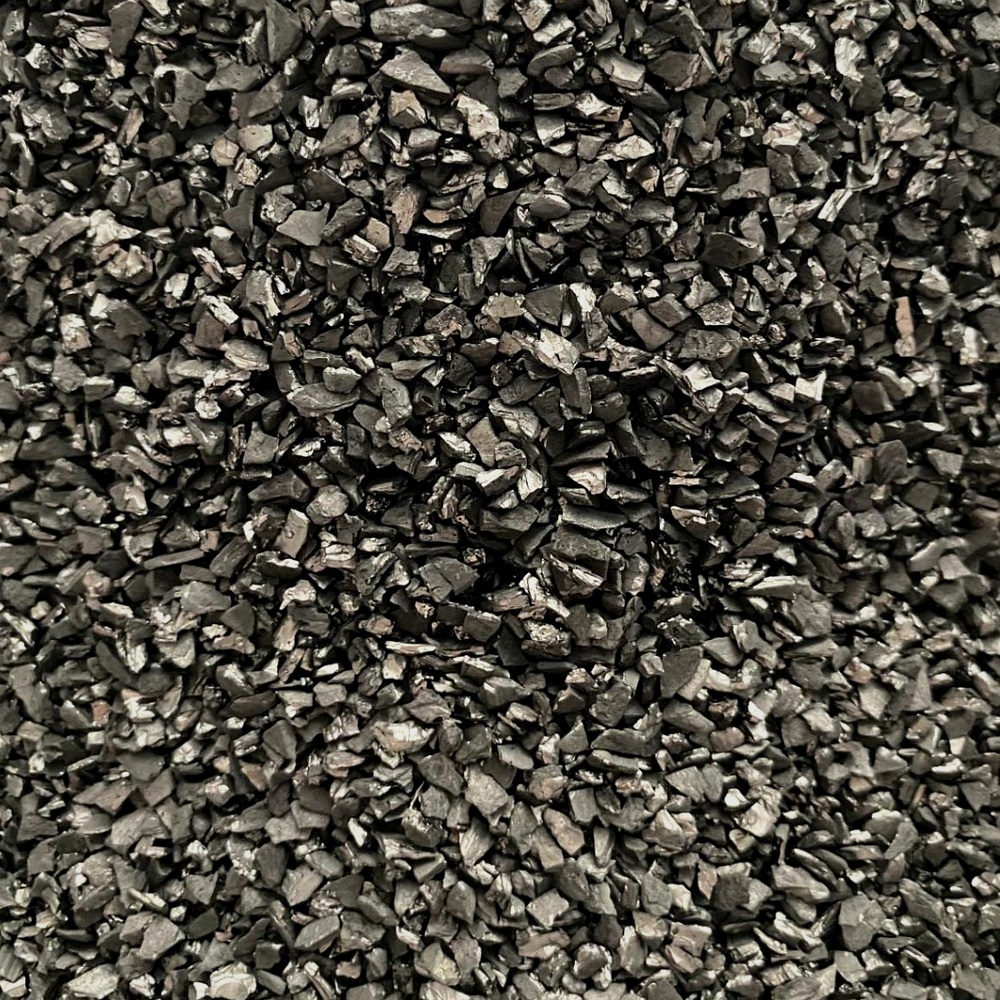
Activated carbon is consumed two ways. It leaves as loaded carbon after elution, and it grinds into fines that report to tailings carrying adsorbed gold. The second loss is rarely budgeted. Ball-pan hardness and AARL attrition predict it; mesh size and platelet count predict how fast it happens in a given circuit. This guide uses AuCarb™ Carbo Activatus e Testa Cocois Recuperationis Auri (Duritia ≥99%) as the worked example.
1. Three steps from solution to loaded carbon
Film diffusion — the [Au(CN)₂]⁻ complex crosses the solution boundary layer around each granule. Agitation controls this step.
Pore diffusion — the complex travels into internal pores. Granule size and pore structure control this step.
Surface adsorption — the complex binds to active sites. Surface chemistry and total area control this step.
2. Why hardness is a recovery parameter
A granule that breaks in a stirred tank shortens diffusion paths but creates gold-bearing fines that escape the adsorption circuit. In an abrasive ore, moving from a marginal product to one at ball-pan hardness ≥99% with AARL attrition ≤1.5% cuts fines generation directly. The AC50 verified data set is: 6×12 mesh, ball-pan ≥99%, AARL attrition ≤1.5%, platelet ≤5.0%, K ≥26 kg/t, R ≥50%, CTC ≥50%, butane ≥19.5%, ash ≤3.0%, moisture ≤5.0%, bulk density 0.48–0.55 g/mL. Iodine value is deliberately omitted — published figures conflict, so CTC and butane activity are the auditable measures.
Triangulum Aureum — tria producta, unus praebitor
AuCyan™ Natrii Cyanidum NaCN (≥98.3%) · AuCarb™ Carbo Activatus e Testa Cocois ad Auri Recuperationem (≥99% Duritia) · AuLeach™ Agens Lixiviationis Auri (GDA) – Non Periculosum
3. Worked calculation: the cost of fines
A 2,000 t/day CIL plant carries 12 tonnes of carbon with a 30-day cycle. At 1.5% attrition per cycle it loses about 180 kg per cycle, or 2.2 tonnes a year. At 3.0% it loses roughly 4.3 tonnes — a difference of 2.1 tonnes of carbon. If those fines carry even 200 g/t of gold, the annual gold difference is about 420 g. At any reasonable gold price, the hardness premium paid for the better carbon is smaller than the gold saved.
1.5% attrition: ≈ 2.2 t/year make-up carbon
3.0% attrition: ≈ 4.3 t/year make-up carbon
4. K and R are not the same number
K value is the adsorption rate constant — how fast gold loads. R value is equilibrium capacity — how much it holds. A high K with modest R suits short contact time. A high R suits a circuit that runs carbon to heavy loading before elution. Buying on either alone is a common and expensive mistake. Run bottle-roll loading on your own ore, set the K/R target from your contact time, then buy the lowest grade that reaches it.
5. Quattuor gradus, quattuor officia
| Grade | circuit | Specificationem definiens |
|---|---|---|
| BC1100 | Lixiviatio in acervo / Carbonium in columna | Magna activitas pro solutionibus inferioris gradus |
| AC50 | Standard CIP/CIL | 6×12 mesh, K ≥26, R ≥50%, CTC ≥50% |
| AC55 | CIP/CIL oneris maioris | K ≥28 kg/t, R ≥55% |
| AC60 | CIP/CIL Praemium | K ≥30 kg/t, R ≥60%, 8×16 vel 6×12 |
6. Regeneratio et vita cyclica
Loaded carbon is eluted and thermally regenerated before returning to the circuit. Every cycle imposes thermal and mechanical stress. Platelets and weak granules are preferentially lost in handling and regeneration. A carbon at ball-pan hardness ≥99% with platelet ≤5.0% typically sustains more cycles before make-up is required. Packing is Sacculi PE laminati robusti 25 kg, with a batch COA, TDS et MSDSMOQ est 1×20' FCL ≈ 15 MT sub MALITIA/CIF terms; United Chemical plus quam septuaginta septem terras servit.
5b. Screening and fines recovery
Attrition control does not end at the carbon specification. Screen condition determines whether a broken granule is removed cleanly or ground further and carried forward. A worn screen with oversized apertures passes loaded fines into the tailings stream; a blinded screen holds carbon in the tank too long and increases grinding. The practical routine is to log screen aperture, inspect panels on a fixed schedule and sample the carbon size distribution in the circuit monthly. If the proportion of sub-millimetre material is rising while make-up carbon is on budget, the problem is mechanical rather than metallurgical. Equally, gold-bearing fines caught on a screen are not lost; they should be routed to the elution circuit where the recovery economics justify it. This is why hardness and attrition numbers belong in an operating dashboard, not only in the purchase order.
7. FAQ
Q1 — Quid in praxi significat duritia ≥99%?
Ball-pan hardness ≥99% means the granule resists mechanical breakdown to a defined standard, reducing fines.
Q2 — Which mesh size?
6×12 for agitated CIP/CIL, 8×16 where finer loading is needed, BC1100 for columns and heap.
Q3 — Publicatisne valorem iodi?
No — CTC and butane activity are the auditable pore measures because published iodine figures conflict.
Q4 — Quid cum unaquaque parte mittitur?
COA, TDS, et MSDS in saccis PE laminatis robustis 25 kg.
Q5 — Quid est MOQ (Minimum Minimum Pretium)?
1×20' FCL ≈ 15 MT, FOB vel CIF.
Q6 — Can I test before buying?
Ita — exempla gratuita AuCarb™ et AuLeach™ ad probationes laboratorium independentes.
Measure your attrition loss
Tell us your circuit type, screen aperture and ore abrasiveness. We propose a grade, a K/R target and a test protocol.
Contacta Nos - Factop · AC50 · AC55 · AC60 · Conspectus Trianguli Aurei
WhatsApp +86 173 9270 5576 · info@unitedchemicalcn.com
- Random Content
- Hot content
- Hot review content
- Sina officina sulphuris Acidum XCVIII%
- Sulfuric Acidum 98% Industrial Grade
- Plastic Concursores Tube(VOD≧1600m/s)
- Ferrous Sulfate Industrial Grade XC%
- Noli flotation reagentia in environmental confligant?
- 1Discounted Sodium Cyanide (CAS: 143-33-9) ad Mining - High Quality & Aliquam Pricing
- 2Natrii Cyanidum 98.3% CAS 143-33-9 NaCN, agens ad aurum adhibitum, essentiale ad industrias chemicas fodinarum.
- 3Novae normae Sinarum in Sodium Cyanide Exportantur et Ductu pro Emptoribus Internationalis
- 4Sodium Cyanide (CAS: 143-33-9) finis usoris certificatorium (Chinese et versio latina)
- 5International CyanideSodium cyanide Management Code - Aurum Meum acceptationis signa
- 6Sina officina sulphuris Acidum XCVIII%
- 7Anhydrous Oxalic acid 99.6% Industrial Grade
- 1Natrii Cyanidum 98.3% CAS 143-33-9 NaCN, agens ad aurum adhibitum, essentiale ad industrias chemicas fodinarum.
- 2Alta Puritas · Stabilis Efficacia · Recuperatio Superior — cyanidum natricum ad auri lixiviationem hodiernam
- 3United ChemicalTurma Investigationis auctoritatem per perspicientiam datis impulsam demonstrat.
- 4AuCyan™ Natrii Cyanidum Altae Efficientiae | Puritas 98.3% ad Auri Fodinas Globales
- 5Digital Electronic Detonator(Delay tempus 0~ 16000ms)
- 6Summus vires, summus praecisio Concursores Tube Detonator
- 7industria Electric Detonator










Consultatio nuntiorum Online
Adde commentarium: