
AuCyan™ Sodium Cyanide NaCN (≥98.3%): A Technical Manual for Cyanidation Circuit Control
Dissolution chemistry, impurity-driven scaling, a seven-step dosing budget and permit-first scheduling — written for metallurgists and procurement teams running CIP, CIL, CIC, Heap leaching and Vat leaching circuits.
AuCyan™ Sodium Cyanide NaCN (≥98.3%) is a high-purity solid briquette leaching reagent for industrial gold dissolution. Three variables decide its real cost in a plant: how much of the assay reaches the ore as free xyanua, how much reagent is lost to impurity-driven side reactions and Carbonate scaling, and whether the Class 6.1 documentation chain is scheduled before the production campaign begins. Purity above 98% is not a marketing number — it changes the mass balance of the entire circuit.
Các nội dung chính
- Purity is a mass-balance input. At ≥98.3% NaCN, less of each tonne is inert carrier, so dosing calculations drift less between batches.
- Low NaOH and Na₂CO₃ reduce scaling. Controlled alkali limits carbonate deposition on pumps, pipelines, emitters and inter-stage screens where hard or saline water is recirculated.
- Insolubles at 0.02% protect dosing equipment. Ultra-low insoluble matter keeps solution make-up systems and heap emitters from plugging over a long campaign.
- Free cyanide must be measured, not assumed. A titration routine beats a fixed dosing rule whenever ore type, clay content or sulphide grade changes.
- Documentation gates production. UN 1689, Class 6.1, an End-User Certificate and verified import permits must be closed before the factory schedules the batch.
- The briquette form is a logistics decision. It survives maritime transit and inland temperature swings better than fine powder and keeps handling exposure lower at the plant.
Sản phẩm: Natri xyanua (NaCN) AuCyan™ (≥98.3%) · Form: solid briquette · Benchmark: GB/T 19306-2003 superior grade · Transport: UN 1689, Class 6.1 dangerous goods · Documentation: End-User Certificate (EUC) plus destination import permit · Terms: FOB or CIF only · Minimum order: 18 MT per 1×20' FCL · Batch documents: COA, TDS, MSDS · Supply coverage: mining operations in more than 77 countries.
| Kiểm tra hàng | Tiêu chuẩn | Đặc trưng (%) | Tại sao nó quan trọng |
|---|---|---|---|
| NaCN | ≥ 98.0% | 98.3 | Free cyanide available per tonne |
| NaOH | ≤0.5% | 0.13% | Alkalinity without excess caustic |
| Na₂CO₃ | ≤0.5% | 0.18% | Carbonate scaling tendency |
| Chất không tan | ≤0.05% | 0.02% | Dosing line and emitter blockage |
1. What purity actually changes in the dissolution circuit
Gold dissolution in an alkaline cyanide solution follows the Elsner relationship: 4Au + 8NaCN + O₂ + 2H₂O → 4Na[Au(CN)₂] + 4NaOH. The reaction needs three things at once — free cyanide, dissolved oxygen and a protective alkaline environment, typically pH 10.5–11.5. If any one is short, the others cannot compensate. This is why a plant can raise dosing and still see flat recovery: the limiting reagent may be oxygen transfer or pH stability rather than cyanide mass.
The assay figure decides how much of the delivered tonne participates in that reaction. A lower-grade product carries more inert salt and more alkali, so a dosing pump set from a nominal recipe under-delivers free cyanide. Operators then compensate by raising the set-point, which pushes excess reagent into side reactions with copper, iron, arsenic and sulphide minerals. Higher purity narrows that correction loop and makes the consumption curve predictable across batches.
In practice the difference shows up in three places: the dissolution rate in the first hours of leaching, the residual cyanide in the tailings stream, and the reagent spend per tonne of ore. All three are measurable, and all three should be tracked against the batch COA rather than against a generic datasheet.
2. Four failure modes driven by impurities
2.1 Excess alkali and pH drift
Free NaOH is needed to keep the circuit out of the acidic range where hydrogen cyanide can form, but excess caustic consumes reagent without dissolving gold and accelerates the precipitation of metal hydroxides that coat particle surfaces. A controlled NaOH level keeps alkalinity in band with less lime correction.
2.2 Carbonate scaling
Sodium carbonate builds up as cyanide degrades and as carbon dioxide enters with make-up water. In hard or saline recirculating water it deposits on impellers, pump casings, pipeline walls, heap emitters and carbon screens. Scale reduces flow, distorts residence time and creates blind spots in the leach circuit. Low initial Na₂CO₃ delays the onset; regular monitoring keeps the cleaning interval predictable.
2.3 Insoluble blockage
Insolubles do not dissolve. They accumulate in strainers, dosing nozzles and drip emitters, and on long heap campaigns they change the distribution of solution across the pad. Uneven wetting produces channeling, poor recovery in dry zones and misleading composite samples. Ultra-low insolubles are therefore a hydraulic control, not just a purity statistic.
2.4 Cyanide-consuming gangue
Copper minerals, pyrrhotite, arsenopyrite and partially oxidised sulphides form stable cyanocomplexes and thiocyanate. The reagent is not wasted by the gold reaction but by the mineralogy. When a plant changes ore source or blend, the consumption baseline must be re-established with bottle roll or column tests rather than carried over from the previous block.
3. Tutorial: build a NaCN dosing budget in seven steps
- Mô tả đặc điểm của quặng. Record head grade, clay fraction, sulphide and copper content, and the particle size distribution reaching the leach feed. These four parameters set the expected side-reaction demand.
- Run a bottle roll test at the intended pH and pulp density, sampling dissolved gold and free cyanide at 2, 6, 12 and 24 hours. Plot the curve rather than reading only the endpoint.
- Fix the free-cyanide target for the circuit — a working band, not a single number — and define the titration method used to verify it, typically silver nitrate titration with an appropriate indicator.
- Convert to kg/t of ore. Translate the laboratory consumption into a plant dosing rate using pulp density and throughput, then add a defined allowance for gangue demand.
- Build the addition profile. Front-load the dose where the dissolution curve is steep, taper it as the curve flattens, and avoid a flat continuous feed that wastes reagent in the final hours.
- Verify against the batch COA. Compare the actual assay of the delivered lot with the assumption used in step 3, and correct the pump set-point if the NaCN assay differs.
- Close the record loop. Log consumption, residual cyanide, dissolved oxygen, pH and recovery against each lot. Batch COA, TDS and MSDS should sit next to that log so deviations can be traced to a specific delivery.
This budget is a living document. A brownfield expansion, a new ore block or a change in make-up water quality resets at least one of the seven inputs, so the budget should be reviewed whenever the circuit feed changes.
4. Bảng khắc phục sự cố
| Triệu chứng | Nguyên nhân có thể | Kiểm tra đầu tiên |
|---|---|---|
| Slow dissolution, flat recovery | Oxygen transfer or pH limiting, not cyanide mass | Dissolved oxygen, pH profile, grind size |
| Consumption rising at same grade | New gangue or copper-bearing blend | Ore mineralogy, thiocyanate in solution |
| Scale on pumps and screens | Carbonate build-up, hard make-up water | Water hardness, Na₂CO₃ trend, cleaning interval |
| Dosing line or emitter plugging | Insolubles or precipitated salts | Strainer residue, insoluble assay on COA |
| pH drifting downward | Acidic ore, insufficient alkalinity control | Lime addition, NaOH on COA, buffering capacity |
| High residual cyanide in tails | Over-dosing after dissolution plateau | Hồ sơ bổ sung, tần suất chuẩn độ |
5. Permit-first scheduling: the commercial constraint
Sodium cyanide is classified as UN 1689, Class 6.1 dangerous goods. Before a production slot is reserved, the destination import permit and the End-User Certificate must be verified. Dangerous-goods booking, packaging, inland transfer and port acceptance all sit behind that gate. Teams that build the documentation chain into the project calendar avoid idle reagent, missed campaigns and demurrage; teams that treat it as post-order paperwork absorb the cost later.
United Chemical vật tư Natri xyanua (NaCN) AuCyan™ (≥98.3%) factory-direct at 18 MT MOQ under FOB or CIF terms, with batch COA, TDS and MSDS issued per lot. Where a cyanide permit is the binding constraint, evaluate Chất hòa tan vàng AuLeach™ (GDA) – Không độc hại as a common-chemical route. For the adsorption stage, pair the leach circuit with Than hoạt tính từ vỏ dừa AuCarb™ giúp thu hồi vàng (độ cứng ≥99%).
6. Where the three products sit in one flowsheet
| Traineeship | Sản phẩm | Biến quyết định |
|---|---|---|
| Hòa tan / rửa trôi | Natri xyanua (NaCN) AuCyan™ (≥98.3%) | Purity, free-cyanide control, permit status |
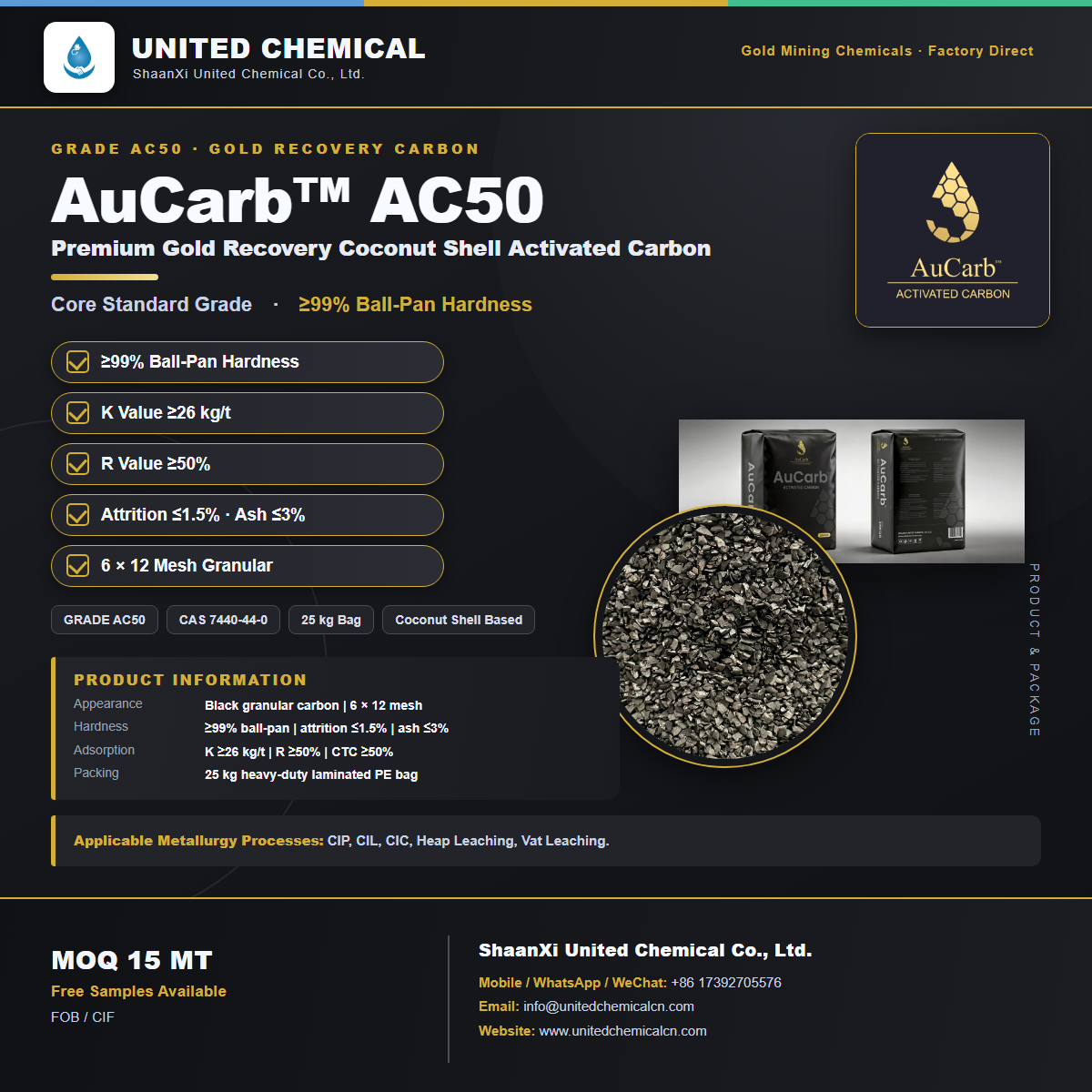
| Hấp phụ / phục hồi | Than hoạt tính từ vỏ dừa AuCarb™ giúp thu hồi vàng (độ cứng ≥99%) | Độ cứng, giá trị K/R, độ mài mòn, kích thước mắt lưới |
| Tuyến đường lọc thay thế | Chất hòa tan vàng AuLeach™ (GDA) – Không độc hại | Common-chemical classification, pH band, ore validation |
AngloGold Ashanti announced on 5 November 2026 a three-year brownfield programme of US$750 million to US$900 million across Geita (Tanzania), Siguiri (Guinea), Cuiabá (Brazil) and Obuasi (Ghana), targeting at least 400,000 additional ounces of annual output by 2030. Geita alone is guided toward roughly 600,000 oz/y against 492,000 oz in 2025. Brownfield expansions of this kind do not replace the leaching circuit — they raise throughput on an existing footprint, which makes reagent consistency and delivery scheduling more valuable, not less. Nguồn: Thông báo cập nhật và mở rộng kinh doanh quý 3 năm 2026 của công ty, ngày 5 tháng 11 năm 2026.
7. Câu hỏi thường gặp
Q1. Why specify NaCN ≥98.3% instead of a commodity grade?
Because the assay directly sets the free cyanide delivered per tonne. A tighter assay reduces dosing correction, limits side reactions and keeps the consumption curve stable across lots.
Q2. Which impurity matters most for a hard-water CIL plant?
Na₂CO₃, because carbonate scaling affects pumps, pipelines, emitters and screens. NaOH controls alkalinity, and insolubles control blockage — all three appear on the batch COA.
Q3. What pH band should a cyanidation circuit hold?
Typically pH 10.5–11.5. Below that the protective alkaline environment degrades; far above it reagent is consumed without dissolving additional gold.
Q4. How is free cyanide measured in the plant?
By routine titration of the leach solution, commonly with silver nitrate and an appropriate indicator, sampled at defined points rather than inferred from the dosing pump set-point.
Q5. Why does consumption rise when the ore source changes?
Copper minerals, sulphides and clay form cyanocomplexes or adsorb reagent. The baseline must be re-established with bottle roll or column tests for each new blend.
Q6. What documents are required before an order ships?
A verified destination import permit and an End-User Certificate, plus the dangerous-goods documentation for UN 1689, Class 6.1. Batch COA, TDS and MSDS accompany each lot.
Câu 7. Những điều khoản Incoterms nào có sẵn?
Điều khoản FOB hoặc CIF áp dụng cho dòng sản phẩm này.
Câu 8. Số lượng đặt hàng tối thiểu là bao nhiêu?
18 MT per 1×20' FCL, supplied factory-direct with a single documentation standard across the order.
Q9. Why is the briquette form preferred over powder?
It holds up through maritime transit and inland temperature swings and reduces handling exposure during make-up at the plant.
Q10. Can AuCyan™ be evaluated alongside a non-hazardous route?
Yes. Where the cyanide permit chain is the binding constraint, AuLeach™ Gold Leaching Agent (GDA) – Non-Hazardous is evaluated against the same ore with its own pH and dosage validation.
Q11. How should a first order be qualified technically?
Against the batch TDS and COA, with laboratory validation on the plant's own ore and a defined free-cyanide control band before the FCL campaign begins.
Q12. Which adsorption product completes the circuit?
AuCarb™ Gold Recovery Coconut Shell Activated Carbon (≥99% Hardness), selected by K/R value, attrition limit and mesh cut for the duty of the specific CIP or CIL stage.
8. Tài liệu kỹ thuật và liên kết nội bộ
AuCyan™ Sodium Cyanide product page · Tổng quan về Tam giác vàng · Tổng quan kỹ thuật ba sản phẩm · Sodium cyanide technical reference · AuCarb™ activated carbon guide · AC50 specification · AC55 specification · AC60 specification · BC1100 specification · Trang sản phẩm AuLeach™ GDA · Tài liệu tham khảo về thuốc thử dùng trong quá trình chiết tách · Câu hỏi thường gặp về hóa chất · Tin tức Công nghiệp
Request a quotation, TDS and batch COA, or discuss a dosing budget for your ore: Liên Hệ Với Chúng Tôi · WhatsApp +86 173 9270 5576 · info@unitedchemicalcn.com
- Nội dung ngẫu nhiên
- nội dung hấp dẫn
- Nội dung đánh giá nóng
- Chuyên gia quan hệ khách hàng và nhà cung cấp linh hoạt (: Indonesia)
- Kíp nổ điện tử kỹ thuật số (Thời gian trễ 0~ 16000ms)
- Kali Permanganat – Cấp công nghiệp
- Thiourea 99% hoạt động cao Nhà sản xuất chuyên nghiệp
- Natri Nitrit Công Nghiệp 98.5%
- Làm thế nào để chọn đúng thuốc thử tuyển nổi?
- Có quy định cụ thể nào về việc sử dụng hóa chất khai thác không?
- 1Natri xyanua giảm giá (CAS: 143-33-9) cho khai thác - Chất lượng cao & Giá cả cạnh tranh
- 2Natri xyanua 98.3% CAS 143-33-9 NaCN là chất phụ gia thiết yếu cho ngành công nghiệp hóa chất khai thác mỏ.
- 3Quy định mới của Trung Quốc về xuất khẩu natri xyanua và hướng dẫn cho người mua quốc tế
- 4Natri xyanua (CAS: 143-33-9) Giấy chứng nhận người dùng cuối (phiên bản tiếng Trung và tiếng Anh)
- 5Tiêu chuẩn quản lý xyanua quốc tế (natri xyanua) - Tiêu chuẩn chấp nhận khai thác vàng
- 6Nhà máy Trung Quốc Axit Sunfuric 98%
- 7Axit oxalic khan 99.6% Cấp công nghiệp
- 1Natri xyanua 98.3% CAS 143-33-9 NaCN là chất phụ gia thiết yếu cho ngành công nghiệp hóa chất khai thác mỏ.
- 2Độ tinh khiết cao · Hiệu suất ổn định · Khả năng thu hồi cao hơn — natri xyanua cho quá trình chiết xuất vàng hiện đại
- 3United ChemicalNhóm nghiên cứu của 's chứng minh thẩm quyền thông qua thông tin chi tiết dựa trên dữ liệu
- 4Natri xyanua hiệu suất cao AuCyan™ | Độ tinh khiết 98.3% dành cho ngành khai thác vàng toàn cầu
- 5Kíp nổ điện tử kỹ thuật số (Thời gian trễ 0~ 16000ms)
- 6Kíp nổ ống xung kích có độ chính xác cao, cường độ cao
- 7ngành công nghiệp Máy nổ điện


Tư vấn tin nhắn trực tuyến
Thêm bình luận: