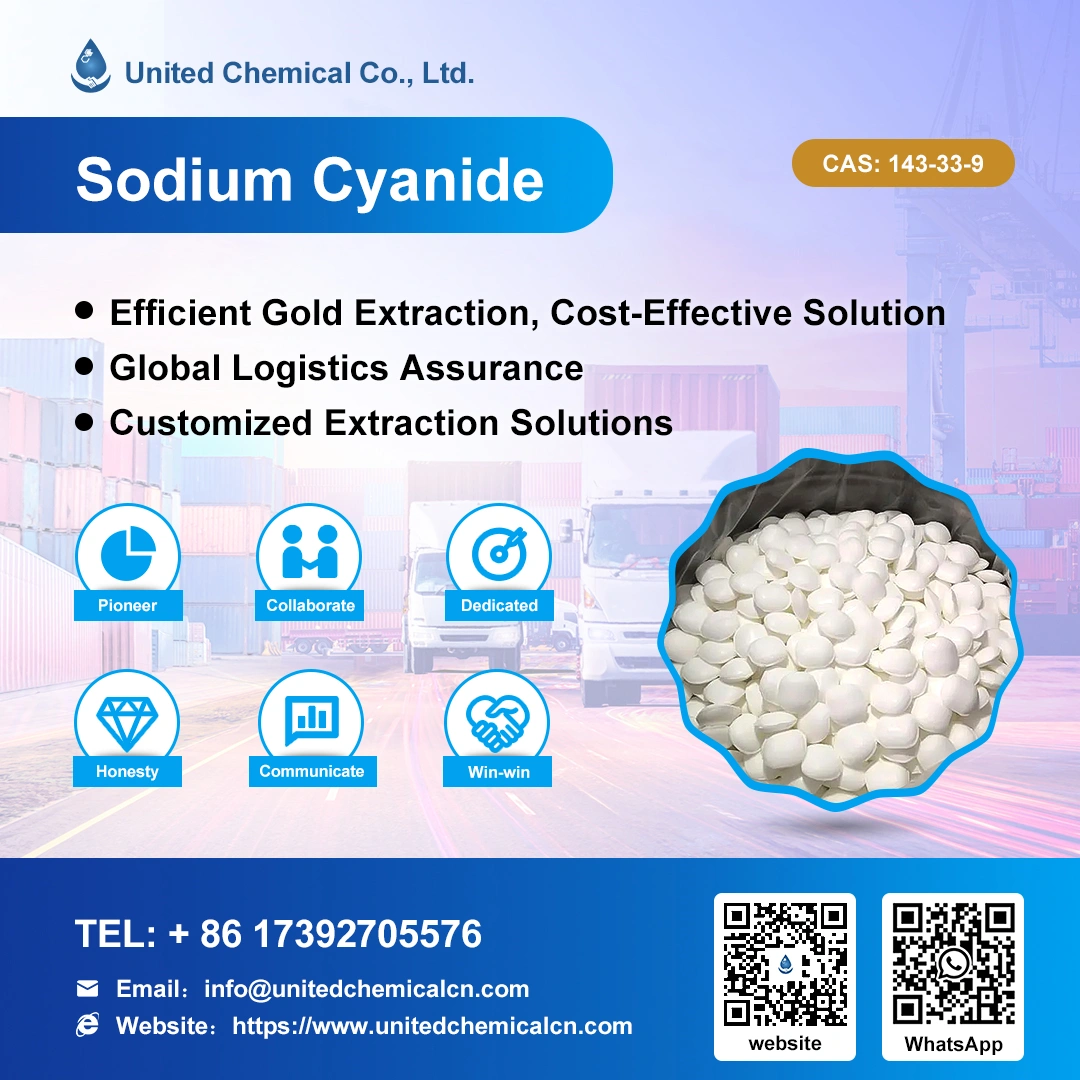

The Golden Triangle of Gold Recovery
As a premier global one-stop supplier of gold mining chemicals, United Chemical delivers an elite product line covering the complete metallurgical circuit: Leaching – Adsorption – Eco-Friendly Substitution. We empower global mining enterprises to break through extraction efficiency ceilings and maximize gold yield per ton.
Synergy Driven Performance: Whether you are utilizing the industry benchmark AuCyan™, seamlessly pairing it with our premium AuCarb™ coconut activated Carbon for flawless CIP/CIL adsorption, or transitioning to green mining with AuLeach™, our integrated solutions are engineered to work in perfect harmony, minimizing reagent consumption while maximizing your gold bar output.
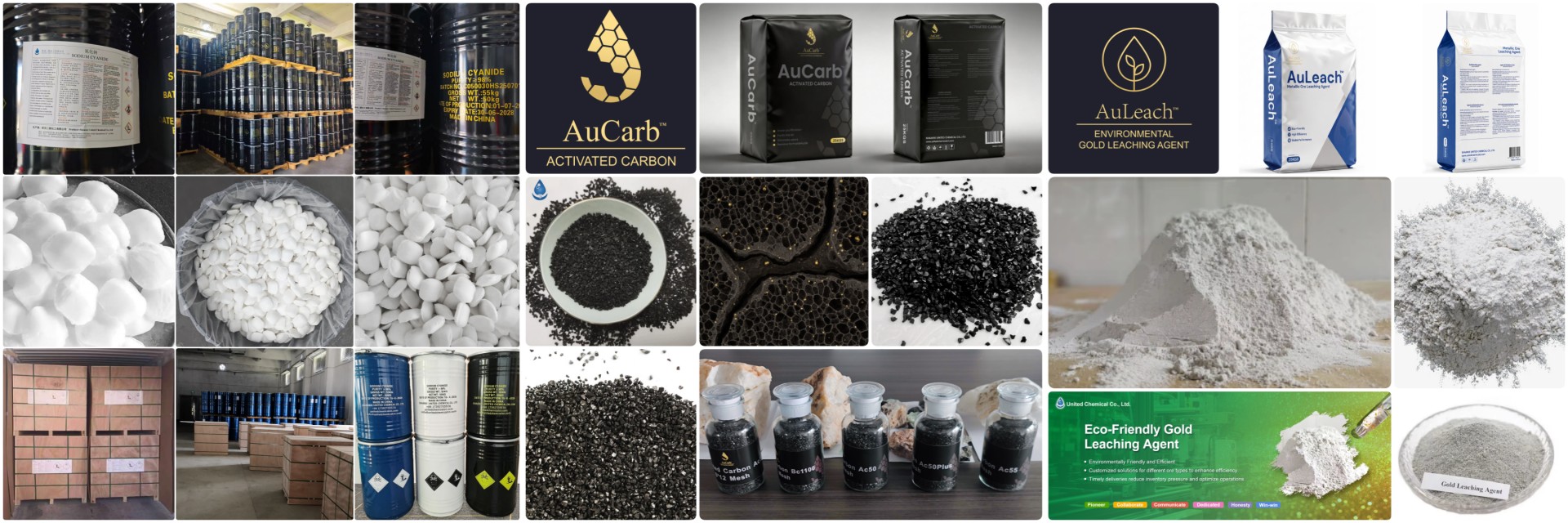
1. AuCyan™ Sodium Cyanide (NaCN)
AuCyan™ Premium Sodium Cyanide ≥98.3; The Industry Standard for Maximum Recovery
Positioning: The performance and purity benchmark for traditional cyanidation in medium-to-large scale gold mining operations.
Core Selling Points:≥98.3% High Purity | Low Reagent Single-Consumption | Full International Hazmat Compliance
AuCyan™ represents United Chemical's pursuit of perfection in foundational mineral processing chemicals. As the most efficient traditional leaching reagent, we adhere to strict industrial standards to ensure batch-to-batch purity and stability, providing essential momentum for gold mining facilities worldwide. When paired with high-quality Activated Carbon, it ensures the most efficient dissolution and capture of gold ions.
≥98.3% High-Purity Standard: Purity levels far exceeding industry standards guarantee maximum active free cyanide ions (CN−) during cyanidation. This drastically accelerates gold/silver dissolution kinetics and maximizes overall leaching efficiency.
Cost-Effective Consumption Control: Ultra-low impurity levels minimize unwanted side-reactions with accompanying minerals (such as copper, iron, and sulfur) in the leaching slurry, significantly lowering reagent consumption per ton of ore processed.
Global-Grade Export Compliance & Delivery: As a regulated dangerous good, supply chain expertise is paramount. United Chemical holds robust UN-certified packaging solutions (steel drums, wooden boxes, Isotanks) and international export qualifications, guaranteeing smooth, safe, and compliant delivery to over 90 gold-producing nations.
📊 Technical Specification: The 98.3% Purity Standard
Surpassing industry benchmarks, our latest production batches consistently achieve "Superior Quality" grades. Below is the certified performance data (Ref: Batch C050030HS251101).
| Testing Items | Standard (GB/T 19306-2003) | AuCyan™ (Typical) | Operational Impact |
|---|---|---|---|
| Sodium Cyanide (NaCN) | ≥ 98.0% | 98.3% | Maximum gold dissolution kinetics and recovery rates. |
| Sodium Hydroxide (NaOH) | ≤ 0.5% | 0.13% | Superior pH stability; prevents premature hydrolysis. |
| Sodium Carbonate (Na₂CO₃) | ≤ 0.5% | 0.18% | Minimized impurity interference in the leaching solution. |
| Moisture (H₂O) | ≤ 0.9% | 0.3% | Enhanced solid stability during long-term storage and sea transit. |
| Insoluble Substances | ≤ 0.05% | 0.02% | Anti-clogging formula; protects critical pumps and nozzles. |
2. AuCarb™ Gold Recovery Coconut Shell Activated Carbon
AuCarb™ Gold Recovery Coconut Shell Activated Carbon – Precision Adsorption, Zero Gold Loss
Positioning: Custom-engineered high-strength, high-adsorption coconut carbon tailored for CIP / CIL / CIC gold recovery circuits.
Core Selling Points: Ultra-High Hardness (≥99%) | Rapid Gold-Complex Adsorption Kinetics | High Reactivation Yield
In CIP/CIL processes, activated carbon quality directly determines final gold output. AuCarb™ is custom-developed for harsh agitation environments, refined from top-tier Sri Lankan and Southeast Asian Coconut Shells through high-temperature activation and polishing treatments. It is designed to act as the ultimate gold capture matrix, perfectly complimenting our leaching agents.
Ultra-High Hardness & Attrition Resistance (Minimal Gold Loss): Mine operators fear carbon attrition in leach tanks leading to gold fines loss. AuCarb™ undergoes special hardening treatment to achieve a hardness rating above ≥99%, completely eliminating costly "gold-bearing carbon" breakdown.
Rapid & High-Capacity Pore Architecture (High Adsorption Kinetics): Gold-cyanide complexes are larger molecular structures. AuCarb™ features a precisely controlled ratio of micro-pores to meso-pores, ensuring rapid entry and firm entrapment of [Au(CN)₂]⁻ complexes with loading capacity far surpassing standard activated carbons.
Extended Service Life & High Reactivation Yield: Following desorption-electrowinning, AuCarb™ recovers over 95% of its original activity after thermal reactivation. It can be recycled through multiple cycles, significantly lowering carbon replacement costs per ton of gold produced.
📊 AuCarb™ Series: Core Parameters Intuitive Comparison Table
To facilitate a more intuitive selection process tailored to your specific metallurgy circuit, we have summarized the core technical parameters of our four flagship AuCarb™ variants.
| Core Testing Parameter | AuCarb™ BC1100 | AuCarb™ AC50 | AuCarb™ AC55 | AuCarb™ AC60 |
|---|---|---|---|---|
| Market Benchmarking Positioning | Conventional Heap Leach | Comparable: Jacobi G208AS | Comparable: Jacobi G209AS | Advanced: Jacobi G210AS |
| Apparent Density | 0.40 - 0.50 g/ml | 0.48 - 0.55 g/ml | 0.45 - 0.55 g/ml | 0.45 - 0.55 g/ml |
| Ball-pan Hardness | ≥ 98.5% | ≥ 99% | ≥ 99% | ≥ 99% |
| Platelet Content | ≤ 5% | ≤ 5% | ≤ 5% | ≤ 5% |
| Attrition | ≤ 2% | ≤ 1.5% | ≤ 2% | ≤ 2% |
| Total Ash Content | ≤ 5% | ≤ 3% | ≤ 3% | ≤ 3% |
| Moisture | ≤ 10% | ≤ 5% | ≤ 5% | ≤ 5% |
| Adsorption Capacity (K Value) | / | ≥ 26 Kg/t | ≥ 28 Kg/t | ≥ 30 Kg/t |
| Adsorption Rate (R Value) | / | ≥ 50% | ≥ 55% | ≥ 60% |
| Iodine Number | ≥ 1100 mg/g | / | / | / |
| Butane Activity | / | ≥ 19.5% | ≥ 21% | ≥ 23% |
| CTC (Carbon Tetrachloride Activity) | / | ≥ 50% | ≥ 55% | / |
* Execution Standards: Complies with American ASTM standards and A.A.R.L. internal mining testing standards. The product has passed third-party inspection and test samples can be provided upon request.
3. AuLeach™ Eco-Friendly Gold Leaching Agent (GDA)
AuLeach™ Gold Leaching Agent (GDA) – The Eco-Friendly Cyanide Substitute
Positioning: A non-toxic leaching agent balancing high recovery yields with strict HSE environmental compliance.
Core Selling Points: General Cargo Export (Non-Hazardous) | Zero Equipment Modification | Superior Yield on Refractory Ores
Faced with increasingly stringent global environmental regulations (HSE), many gold mines face restrictions or bans on cyanide usage. AuLeach™ Eco-Friendly Gold Leaching Agent offers the perfect 100% green replacement for Sodium Cyanide, aligning "green mining" with high financial returns.
Seamless Direct Drop-in Replacement: Transitioning to AuLeach™ requires zero modification to existing cyanidation equipment (such as Heap Leaching or CIL circuits). It can be directly substituted for sodium cyanide at 1:1 or recommended ratios to immediately start production.
Non-Toxic Certification & Streamlined Approval (HSE Compliance): Officially certified as a general chemical (Non-Hazmat). This dramatically reduces ocean freight, land logistics, and insurance costs while eliminating tedious toxic chemical permit approvals, cutting mine commissioning lead times by over 50%.
Faster Kinetics & Superior Performance on Refractory Ores: When treating complex, refractory gold ores containing arsenic or sulfur, AuLeach™ exhibits superior resistance to interference and faster leaching kinetics compared to NaCN, frequently achieving a 2% to 5% increase in absolute recovery rate.
Safe Working Environment & ESG Value: Drastically reduces occupational health risks for operational personnel and minimizes environmental contamination hazards, making it the preferred reagent for modern mining companies seeking high ESG ratings.
📊 AuLeach™ Technical Information & Specifications
| Parameter | Units | Guaranteed Specification |
|---|---|---|
| Appearance | - | Solid Powder |
| Operational pH Range | - | 10.5 - 12 |
| Leaching Agent Concentration | % | 30 |
| Standard Packaging | Kgs | Net 25Kgs bag |
Broad Application Spectrum: Highly effective across primary ores, oxide ores, semi-oxide ores, sulfide ores, gold concentrates, and cyanide tailings in both Carbon-in-Pulp and Pool/Vat leaching circuits.
Zero Equipment CAPEX: Fully compatible with existing Chilean Heap leaching and CIL infrastructure. Requires absolutely no mechanical retrofitting.
Unrestricted Logistics: Shipped and trucked as general cargo, eliminating the exorbitant costs of hazardous goods import permits at ports like Antofagasta and specialized DG escorts across the Atacama.
💡 United Chemical: Your Trusted Partner from Ore to Gold Bar
From high-efficiency leaching (AuCyan™ / AuLeach™) to precision adsorption enrichment (AuCarb™), United Chemical provides an industry-leading "Golden Triangle" solution matrix. We are more than chemical manufacturers—we are technical experts committed to maximizing the economic yield of every ton of your ore.
📊 Product Matrix Comparison & Selection Guide
💡 Product Highlights Quick Overview
AuCyan™ Sodium Cyanide
≥98.3% High-purity NaCN. The industry standard for maximum leaching kinetics and low reagent consumption.
High active CN− concentration
UN-certified export compliance
Ideal for CIL, CIP & Heap Leaching
AuCarb™ Activated Carbon
Premium coconut shell activated carbon with ≥99% hardness to minimize gold loss during CIL/CIP agitation.
Ultra-high attrition resistance
Fast gold adsorption kinetics
>95% Activity recovery after desorption
AuLeach™ Leaching Agent
Non-toxic 100% cyanide alternative (GDA). Seamless drop-in replacement with fast customs clearance.
Non-hazardous logistics & easy clearance
Zero equipment modification needed
Higher recovery on refractory ores
Frequently Asked Questions: The Golden Triangle
Explore our comprehensive technical, logistical, and metallurgical database. From managing complex high-copper ores to navigating global hazardous logistics, find expert answers covering AuCyan™, AuCarb™, and AuLeach™.
Part 1: The Golden Triangle Strategy & Corporate Supply
1. What exactly is the "Golden Triangle" of gold recovery? ▼
The Golden Triangle represents United Chemical's proprietary matrix of three essential mining reagents: AuCyan™ (high-purity Sodium cyanide for traditional leaching), AuCarb™ (ultra-hard activated carbon for capturing dissolved gold), and AuLeach™ (an eco-friendly, non-hazardous leaching alternative). Together, they provide a 360-degree solution for any geological or regulatory challenge globally.
2. Why should our mine source all three products from United Chemical? ▼
Consolidating your supply chain with our Golden Triangle ensures perfect chemical compatibility in your CIL/CIP circuits. Furthermore, bundling these reagents under a single factory-direct supplier optimizes maritime container space, reduces aggregate freight costs, and simplifies customs clearance.
3. What is the Minimum Order Quantity (MOQ) for international exports? ▼
To ensure factory-direct pricing, protect packaging integrity, and optimize maritime freight, our strict Minimum Order Quantity (MOQ) across all products is 1x20' FCL (Full Container Load).
4. Do you provide free laboratory samples for metallurgical testing? ▼
Yes, we provide complimentary laboratory samples strictly for AuCarb™ Activated Carbon and AuLeach™ Eco-Friendly Agent. Due to strict international hazardous materials regulations, we cannot dispatch small samples of AuCyan™ (Sodium Cyanide) via express air freight.
5. Which global regions do you currently supply? ▼
United Chemical proudly exports to over 77 countries, dominating major mining hubs including Latin America (Mexico, Peru, Chile), Africa (Ghana, Mali, Tanzania), Southeast Asia (Indonesia, Philippines), and Central Asia.
6. How do the Golden Triangle products reduce overall CAPEX? ▼
All our reagents are engineered as "drop-in" solutions. Whether you use AuCyan™ or transition to the eco-friendly AuLeach™, you require zero equipment modification to your existing Heap leach pads or CIL/CIP tanks, eliminating heavy capital expenditures (CAPEX).
7. Can you provide metallurgical consulting for complex ores? ▼
Yes, our technical engineering team analyzes your specific ore characteristics (e.g., silver ratio, copper content, clay viscosity) and recommends the precise AuCarb™ mesh size and leaching reagent concentration to optimize your recovery curve.
8. Do you support OEM or White-Label packaging for regional distributors? ▼
Yes, for qualified international distributors ordering consistently in bulk, we offer customized OEM packaging solutions, particularly for AuCarb™ and AuLeach™, ensuring your brand maintains a strong regional presence.
9. What is the typical lead time from order confirmation to port dispatch? ▼
For standard 1x20' FCL orders, production and custom packaging are typically completed within 10 to 14 business days, ready for immediate loading onto vessels at major Chinese maritime ports.
10. Are your products certified by international testing authorities? ▼
Absolutely. AuCyan™ complies strictly with GB/T 19306 standards, AuCarb™ is tested under ASTM and AARL methodologies, and AuLeach™ is certified by global testing agencies (like SGS) as a non-hazardous substance.
11. Do you offer long-term supply contracts to lock in reagent prices? ▼
Yes, for mid-to-large scale mining operations, we establish long-term supply agreements. This stabilizes your OPEX against global chemical market fluctuations and guarantees priority production scheduling.
Part 2: AuCyan™ Sodium Cyanide (NaCN)
12. Why is the ≥98.3% purity of AuCyan™ considered the industry benchmark? ▼
Standard industrial cyanide often tests at 97%. AuCyan™ guarantees ≥98.3% purity. This higher concentration ensures a massive surplus of free CN⁻ ions, which rapidly penetrates complex ore matrices, slashing required leaching times and maximizing yield.
13. How does the low NaOH (≤0.5%) in AuCyan™ benefit my operation? ▼
AuCyan™ maintains sodium hydroxide (NaOH) levels around 0.13%. This provides excellent pH buffering to prevent premature hydrolysis (off-gassing) without causing severe calcium scaling in your Heap Leach drip emitters and pipelines.
14. What form does AuCyan™ come in, and why? ▼
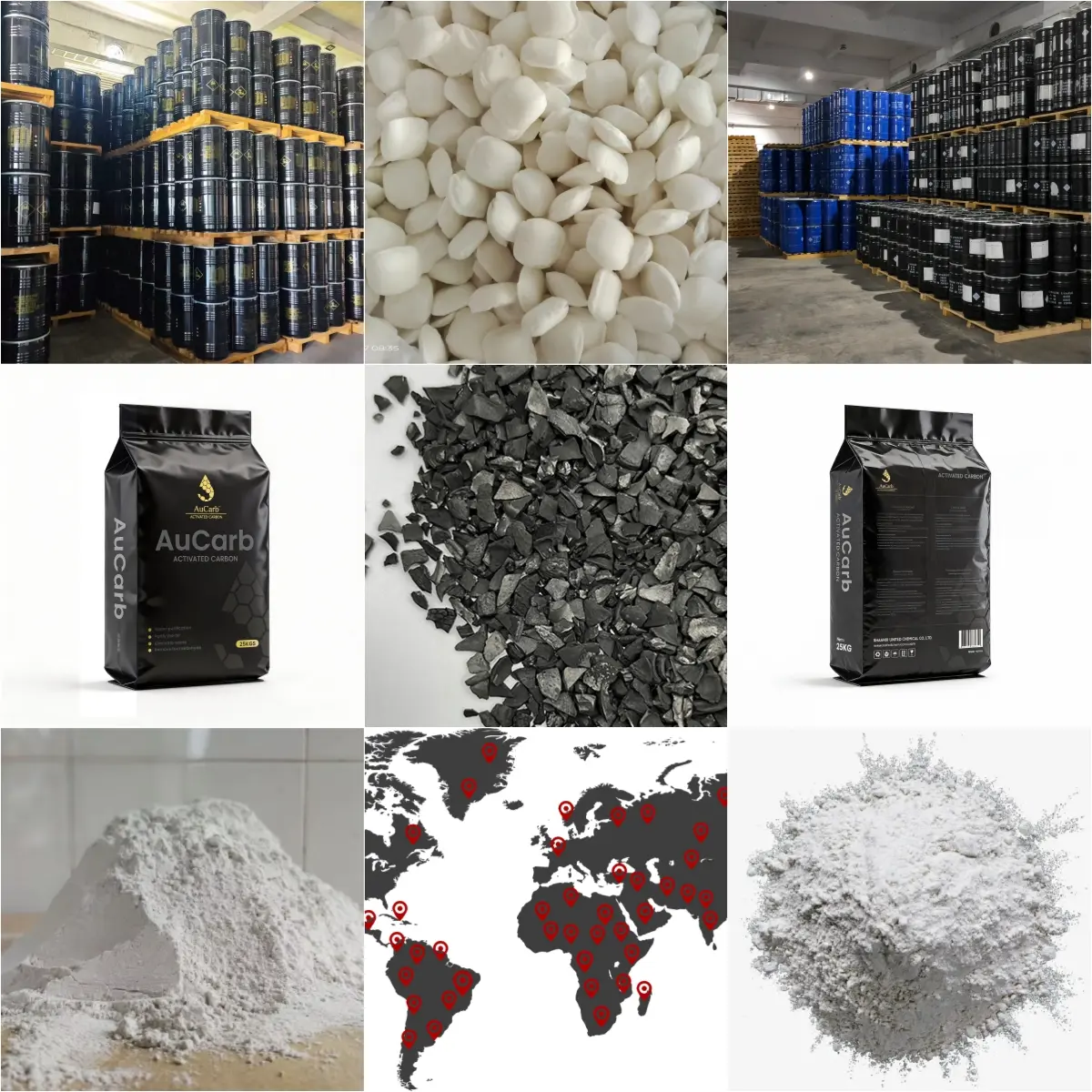
AuCyan™ is manufactured as solid white briquettes (tablets). This shape minimizes dangerous dust generation during handling, dissolves rapidly in mixing tanks, and is highly stable during long ocean transits.
15. How does AuCyan™ handle high copper "cyanicide" ores? ▼
Copper aggressively consumes cyanide. AuCyan™’s ultra-high purity ensures that even after base metals (like copper or zinc) consume their stoichiometric share of CN⁻ ions, sufficient active cyanide remains to rapidly dissolve the target gold particles.
16. What is the typical moisture content, and why does it matter? ▼
AuCyan™ features an ultra-low moisture content of ≤0.3%. High moisture leads to chemical degradation and hazardous ammonia gas buildup inside the drum. Our dry formulation guarantees long-term stability in tropical climates.
17. Does AuCyan™ leave insoluble residues in my mixing tanks? ▼
No. With insoluble substances strictly controlled at ≤0.02%, AuCyan™ dissolves cleanly into a clear liquor, preventing sludge buildup in your tanks and protecting expensive slurry pumps from premature wear.
18. How is AuCyan™ packaged for international maritime transport? ▼
It is exported in UN-certified 50kg hermetically sealed steel drums or 1,000kg reinforced wooden boxes. Both options feature a heavy-duty, heat-sealed Polyethylene (PE) inner liner to completely block atmospheric moisture.
19. What is the UN number and hazard classification for AuCyan™? ▼
AuCyan™ Sodium Cyanide is strictly classified under UN 1689, designated as a Class 6.1 Toxic Substance (Dangerous Goods) under international maritime law.
20. What is the ideal mixing ratio for AuCyan™ in a standard CIL plant? ▼
While it varies by ore type, operators typically mix the solid briquettes with process water to create a high-strength stock solution (typically 10% to 20% NaCN by weight) before dosing it into the leaching circuit to maintain optimal PPM levels.
21. Can AuCyan™ be used for silver extraction? ▼
Absolutely. Silver extraction requires significantly higher cyanide concentrations than gold. AuCyan™’s extreme 98.3% purity is highly sought after by epithermal silver-gold operations (such as in Mexico) to satisfy massive reagent consumption.
22. How long can AuCyan™ be stored on-site? ▼
When kept in its original, unbroken, UN-certified packaging within a dry, well-ventilated warehouse out of direct sunlight, AuCyan™ maintains optimal chemical stability for up to 12 to 24 months.
Part 3: AuCarb™ Activated Carbon
23. Why use coconut shell carbon instead of coal-based carbon for gold? ▼
Coconut shell carbon possesses a naturally dense, micro-porous structure perfectly sized for the [Au(CN)₂]⁻ complex. It offers significantly higher mechanical hardness and a much lower ash content compared to coal or wood-based carbons, minimizing fine gold losses.
24. Why is a ball-pan hardness of ≥99% so critical? ▼
In CIL/CIP tanks, the mechanical agitation is violent. If carbon is soft, it shatters into fine dust that carries adsorbed gold out into the tailings dam. AuCarb™’s ≥99% hardness ensures massive structural integrity, reducing attrition to near zero.
25. What is the difference between 6x12 and 8x16 mesh sizes? ▼
6x12 mesh particles are larger and coarser, commonly used in Heap Leaching (CIC) to handle high flow rates without clogging. 8x16 mesh particles are finer, offering higher surface area for faster adsorption kinetics in CIL/CIP tank agitation.
26. What do the K-Value and R-Value indicate on AuCarb™ specs? ▼
The K-Value (Adsorption Capacity) measures the total amount of gold the carbon can hold at equilibrium (e.g., ≥30 Kg/t). The R-Value (Adsorption Rate) measures how fast the carbon loads gold. AuCarb™ AC60 excels in both, boasting R-Values ≥60%.
27. How does platelet content affect gold recovery? ▼
Platelets are flat, poorly shaped carbon granules that can easily slip through inter-tank screens, carrying gold to the tailings. AuCarb™ guarantees a platelet content of ≤5%, ensuring precision screening and maximum gold retention.
28. Is AuCarb™ compatible with Zadra and AARL stripping circuits? ▼
Yes, AuCarb™ features a pristine pore network that releases gold complexes rapidly under high-temperature/high-pressure elution conditions (both Zadra and AARL), resulting in a highly concentrated pregnant solution for electrowinning.
29. Can AuCarb™ be thermally regenerated? ▼
Absolutely. After acid washing and elution, AuCarb™ can be passed through a rotary kiln at ~700°C. Its high density allows it to recover over 95% of its original activity over multiple cycles, significantly reducing OPEX.
30. How does AuCarb™ handle "preg-robbing" carbonaceous ores? ▼
Preg-robbing ores contain natural carbon that prematurely steals dissolved gold. To combat this, you need an activated carbon with colossal kinetic speed. AuCarb™’s extreme CTC and Iodine numbers allow it to instantly out-compete native carbon for gold complexes.
31. What is the significance of low total ash content (≤3%)? ▼
High ash content indicates inorganic impurities that can blind the carbon's pores and interfere with gold loading. AuCarb™’s ultra-low ash (≤3%) ensures maximum pore availability and cleaner elution profiles.
32. Does AuCarb™ suffer from organic fouling? ▼
While all carbon can adsorb organic matter (like flotation reagents or machine oils), AuCarb™'s specific micro-porous dominance creates a steric hindrance against larger organic molecules, keeping the pores open for gold.
33. How is AuCarb™ packaged for transport? ▼
We strictly pack AuCarb™ in 25kg heavy-duty laminated elastic PE bags or 500kg bulk super sacks, ensuring the granules remain dry and uncrushed during global maritime transit.
Part 4: AuLeach™ Eco-Friendly Agent
34. What exactly is AuLeach™ Gold Leaching Agent? ▼
AuLeach™ (GDA) is a revolutionary, eco-compliant chemical formulated to extract gold without the severe environmental toxicity of sodium cyanide. It provides comparable, and often superior, leaching kinetics.
35. Is AuLeach™ officially classified as a non-hazardous chemical? ▼
Yes, AuLeach™ is certified globally as a Non-Hazardous general cargo. It bypasses toxic DG Class 6.1 legislation, meaning it requires no military escorts, reduces insurance premiums, and sails through customs smoothly.
36. What is the substitution ratio when replacing NaCN with AuLeach™? ▼
AuLeach™ is designed as a direct drop-in substitute. Depending on the ore characteristics, it is typically dosed at a ratio of 1:1 to 1:1.5 compared to your historical sodium cyanide consumption.
37. Do I need to alter my plant’s pH levels for AuLeach™? ▼
No. The guaranteed operational pH range for AuLeach™ is 10.5 - 12. This aligns perfectly with traditional cyanidation circuits, meaning you can continue using standard hydrated lime to manage slurry alkalinity.
38. Are equipment modifications required to switch to AuLeach™? ▼
Zero equipment CAPEX is required. AuLeach™ is fully compatible with existing Heap Leaching irrigation networks, VAT leaching pools, and CIL/CIP mechanical agitators. No mechanical retrofitting is needed.
39. How does AuLeach™ perform on refractory gold ores? ▼
AuLeach™ exhibits superior resistance to interference from arsenic and sulfur. When treating complex refractory ores, it frequently achieves faster leaching kinetics and a 2% to 5% higher absolute recovery rate compared to traditional cyanide.
40. Will using AuLeach™ lower my tailings detoxification costs? ▼
Absolutely. Because it lacks the persistent toxicity of cyanide, treating AuLeach™ tailings requires significantly fewer chemicals (like SO2/Air or Hydrogen Peroxide), slashing your environmental compliance and detox OPEX.
41. How is the concentration of AuLeach™ tested on-site? ▼
Mine laboratories can test AuLeach™ concentration via a standard chemical titration method using a silver nitrate complexing agent and a rhodanine indicator, exactly as your metallurgists currently do for cyanide.
42. How does AuLeach™ impact Environmental, Social, and Governance (ESG) ratings? ▼
Replacing toxic cyanide with AuLeach™ instantly elevates a mining company's ESG profile. It eliminates severe occupational health risks, protects local watersheds, and drastically improves relations with local communities and governments.
43. Is AuLeach™ compatible with activated carbon adsorption? ▼
Yes, the gold complex formed by AuLeach™ is perfectly compatible with coconut shell activated carbon. Pairing it with AuCarb™ ensures a seamless transition in your CIL/CIP recovery and elution phases.
44. How is AuLeach™ packaged? ▼
As a non-hazardous solid powder, AuLeach™ is efficiently packed in standard Net 25kg woven bags with inner moisture-proof liners, making it extremely easy to handle and mix at the plant.
Part 5: Metallurgical Challenges & Ore Processing
45. How should I process highly oxidized laterite clay ores? ▼
High-clay laterites form extremely viscous slurries in CIL tanks, causing massive mechanical shear. You must use AuCarb™ AC60 (≥99% hardness) to prevent carbon from shattering into dust and losing your gold to the tailings.
46. How do I mitigate high silver ratios in epithermal deposits? ▼
Silver requires twice the cyanide to dissolve compared to gold. In high-silver ores (like those in Mexico), you must utilize ultra-pure AuCyan™ (≥98.3%) to provide an overwhelming surplus of CN⁻ ions, ensuring base metals don't exhaust your reagent.
47. Can Heap Leaching be used in sub-zero cold climates? ▼
Yes, but freezing temperatures severely retard chemical kinetics. In high-altitude regions (like the Andes or Central Asia), using the extreme purity of AuCyan™ helps jumpstart and maintain the dissolution equation despite poor thermodynamics.
48. How does AuLeach™ perform in Vat/Pool leaching? ▼
AuLeach™ is highly effective in Vat leaching. Because it is non-toxic, it significantly reduces the environmental risk of pool leakage contaminating groundwater, making it ideal for artisanal and mid-scale operations.
49. How can I prevent severe scaling in Heap Leach drip lines? ▼
Scaling is caused by high calcium and poor pH buffering. AuCyan™ contains strictly controlled Sodium Hydroxide (NaOH ≤0.13%), which stabilizes pH without triggering catastrophic calcium carbonate precipitation in your irrigation network.
50. What is the best carbon mesh size for a standard CIL plant? ▼
For Carbon-in-Leach (CIL) and Carbon-in-Pulp (CIP), 8x16 mesh AuCarb™ is the industry standard. It provides a massive surface area for rapid adsorption while remaining large enough to be caught by standard inter-tank screens.
51. How does saline process water affect gold recovery? ▼
Desert operations often use saline water, which lowers dissolved oxygen and slows leaching. The explosive dissolution rate of high-purity AuCyan™ helps compensate for this lack of oxygen, maintaining acceptable extraction kinetics.
52. Why is my pregnant solution cloudy after elution? ▼
A cloudy pregnant solution often indicates high ash content or soft carbon degrading into fines. Switching to AuCarb™, with its ≤3% ash content and ≥99% hardness, ensures a pristine, clear liquor for electrowinning.
53. How should we handle ores from the transition sulfide zone? ▼
Transition sulfides consume immense oxygen and cyanide. Pre-aeration and lead nitrate conditioning are recommended. Following this, dosing AuCyan™ ensures sufficient active cyanide is available to overpower the remaining cyanicides.
54. What causes organic fouling of activated carbon? ▼
Flotation reagents, machine oils, or humic acids from topsoil can blind carbon pores. AuCarb™’s highly specific microporous structure inherently resists large organic molecules, keeping the vital pores open for the gold complex.
55. Should I use AuCyan™ or AuLeach™ for processing old tailings? ▼
Both work exceptionally well. However, if the tailings dam is near a local community or sensitive watershed, re-processing with AuLeach™ eliminates further toxic accumulation and simplifies final site rehabilitation.
Part 6: Global Maritime Logistics & Supply Chain
56. What maritime trade terms does United Chemical offer? ▼
We exclusively transact under strict FOB (Free On Board) China ports, or CIF (Cost, Insurance, and Freight) to your destination seaport globally.
57. Can you transport sodium cyanide via international railways? ▼
No. Due to severe international safety regulations and the unpredictable nature of cross-border rail infrastructure, we strictly prohibit the use of international railway transport for hazardous chemical exports. We rely 100% on secure maritime freight.
58. How do you supply landlocked mining countries (e.g., Bolivia, Mali)? ▼
For landlocked nations, we ship CIF to the nearest strategic coastal transit hub (e.g., Port of Arica for Bolivia, or Port of Dakar for Mali). From there, your designated local forwarder manages the cross-border road trucking.
59. How does AuLeach™ simplify Southeast Asian archipelago logistics? ▼
In countries like Indonesia and the Philippines, domestic RORO ferries often refuse to carry toxic DG Class 6.1 cargo. Because AuLeach™ is Non-Hazardous, it can be seamlessly loaded onto any domestic ferry as general cargo.
60. How many tons of AuCyan™ fit in a 20ft container? ▼
A standard 1x20' FCL typically holds 20 Metric Tons (MT) of AuCyan™ when packed in 1,000kg wooden boxes, or approximately 18 to 21 MT when packed in 50kg steel drums, depending on precise pallet configurations.
61. How does your packaging survive tropical monsoon and hurricane seasons? ▼
Our UN-certified wooden boxes and steel drums feature integrated, thick Polyethylene (PE) inner liners that are heat-sealed. This creates a hermetic barrier, completely blocking extreme atmospheric humidity during Caribbean hurricanes or Asian monsoons.
62. Do you provide comprehensive marine insurance for CIF shipments? ▼
Yes, all CIF shipments are covered by comprehensive marine insurance, protecting your chemical investment against the risks of trans-oceanic transit, rough seas, and port handling.
63. Will you handle the inland transport from the port to the mine site? ▼
We handle the sea freight directly to your destination port. Once the containers are unloaded, the responsibility is passed cleanly to the buyer's localized logistics agents to manage customs clearance and inland trucking.
64. Are your wooden export boxes fumigated? ▼
Yes, all wooden packaging utilized for AuCyan™ exports undergoes strict IPPC-certified fumigation and is stamped accordingly to comply with global agricultural and customs regulations.
65. What documentation do you provide for customs clearance? ▼
We provide a complete suite of export documentation, including the Commercial Invoice, Packing List, Bill of Lading (B/L), Certificate of Origin (CO), and the comprehensive Material Safety Data Sheet (MSDS).
66. Can we split a 20ft container with both Carbon and Cyanide? ▼
Due to stringent International Maritime Dangerous Goods (IMDG) codes regarding the segregation of hazardous and non-hazardous materials, AuCyan™ (Class 6.1) and AuCarb™ must be shipped in dedicated, separate containers.
Part 7: Environmental, Safety & ESG Compliance
67. How dangerous is sodium cyanide if exposed to water or acid? ▼
If AuCyan™ mixes with water, it hydrolyzes. If it mixes with acids, it immediately releases highly toxic, lethal Hydrogen Cyanide (HCN) gas. It must be stored in a dry, strictly alkaline environment at all times.
68. What PPE is required when handling AuCyan™? ▼
Operators must wear full Personal Protective Equipment (PPE) including chemical-resistant gloves, full-face respirators equipped with specific cyanide gas cartridges, splash-proof goggles, and rubber boots.
69. What is the standard protocol for a sodium cyanide spill? ▼
Do not use water. Dry spills should be carefully swept up and placed into sealed containers. Any contaminated surfaces must be neutralized using a strong alkaline oxidizing solution (like sodium hypochlorite) while personnel wear full respirators.
70. How is AuLeach™ disposed of in the tailings? ▼
Because AuLeach™ is non-hazardous and degrades naturally into non-toxic compounds, it requires minimal to zero specialized chemical detoxification before being discharged to the tailings dam, drastically reducing environmental liabilities.
71. Does United Chemical comply with ISO manufacturing standards? ▼
Yes, our manufacturing facilities operate under strict ISO 9001 (Quality Management) and ISO 14001 (Environmental Management) certifications, ensuring global-grade consistency and safety.
72. Can transitioning to AuLeach™ help us win local community support? ▼
Absolutely. Community protests often stem from the fear of toxic cyanide spills contaminating local water supplies. Implementing the non-toxic AuLeach™ physically eliminates this threat, serving as a powerful PR and community relations tool.
73. What is the INCO process for cyanide destruction? ▼
The INCO SO2/Air process is a common method to detoxify cyanide tailings. It utilizes sulfur dioxide and oxygen, catalyzed by copper, to oxidize toxic free cyanide into relatively harmless cyanate. (Note: Using AuLeach™ eliminates the need for this expensive process).
74. How should a chemical storage facility be designed? ▼
Storage facilities must be elevated, flood-proof, well-ventilated, and completely shielded from direct sunlight and rain. Acids and other reactive chemicals must be strictly quarantined in entirely separate buildings.
75. What are the first aid measures for cyanide exposure? ▼
In case of inhalation or ingestion, move the victim to fresh air immediately and seek emergency medical attention. Cyanide antidote kits (such as Amyl Nitrite, Sodium Nitrite, and Sodium Thiosulfate) must be kept on-site and administered by trained professionals.
76. Does AuCarb™ generate hazardous dust? ▼
No. While basic dust masks should be worn during transfer, AuCarb™ is non-toxic and features an ultra-low attrition rate, minimizing the generation of airborne carbon dust in the plant environment.
77. Are your packaging materials recyclable or eco-friendly? ▼
Yes, the steel drums can be neutralized and recycled, and the robust wooden boxes can be repurposed safely on-site. The inner PE bags should be handled according to local hazardous waste protocols if they contained cyanide.
- Random Content
- Hot content
- Hot review content
- Reagent Grade/Industrial Grade Hydrochloric Acid min.31%
- Sodium Isobutyl Xanthate SIBX 90%
- Oxalic acid for mining 99.6%
- Magneto Electric Detonator(Anti stray current)
- Industrial Sodium Nitrite 98.5%
- What is a settling agent, and how does it work in mining?
- How do I assess the economic viability and effectiveness of mining chemicals?
- 1Discounted Sodium Cyanide (CAS: 143-33-9) for Mining - High Quality & Competitive Pricing
- 2Sodium Cyanide 98.3% CAS 143-33-9 NaCN gold dressing agent Essential for Mining Chemical Industries
- 3China's New Regulations on Sodium Cyanide Exports and Guidance for International Buyers
- 4Sodium Cyanide (CAS: 143-33-9) End user certificate (Chinese and English version)
- 5International Cyanide(Sodium cyanide) Management Code - Gold Mine Acceptance Standards
- 6China factory Sulfuric Acid 98%
- 7Anhydrous Oxalic acid 99.6% Industrial Grade
- 1Sodium Cyanide 98.3% CAS 143-33-9 NaCN gold dressing agent Essential for Mining Chemical Industries
- 2High Purity · Stable Performance · Higher Recovery — sodium cyanide for modern gold leaching
- 3United Chemical's Research Team Demonstrates Authority Through Data-Driven Insights
- 4AuCyan™ High-Performance Sodium Cyanide | 98.3% Purity for Global Gold Mining
- 5Digital Electronic Detonator(Delay time 0~ 16000ms)
- 6High-strength, High-precision Shock Tube Detonator
- 7industry Electric Detonator


Online message consultation
Add comment: